About Canella winterana (L.) Gaertn.
Canella winterana (L.) Gaertn. is a tree with scaly aromatic bark and stout ash-gray branchlets that are distinctly marked by large circular leaf scars.
Inflorescence Features
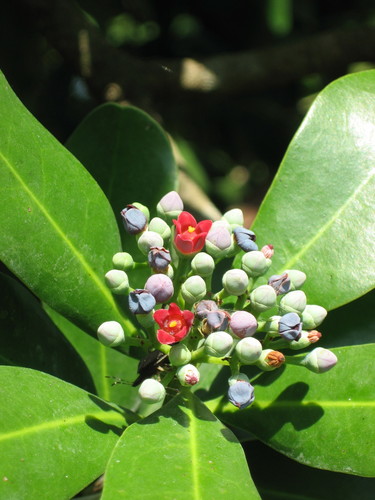
Its flowers are perfect and regular, arranged in many-flowered subcorymbose terminal or subterminal panicles made up of several dichotomously branched cymes growing from the axis of upper leaves or small caducous bracts.
Leaf Characteristics
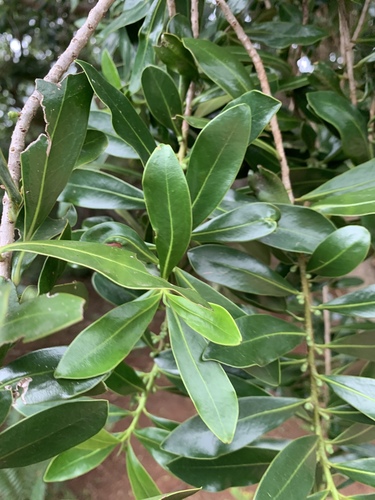
Leaves are petiolate, alternate, lack stipules, are penniveined, entire, pellucid-punctate, and coriaceous; they are obovate, rounded or slightly emarginate at the apex, narrow into a short stout grooved petiole, measure 3.5 to 5.0 inches long and 1.5 to 2.0 inches broad, and are bright deep green and lustrous.
For floral structures
Sepal Traits
there are 3 imbricated persistent sepals, which are suborbiculate, concave, coriaceous, erect, and have ciliate margins.
Petal Traits
There are 5 imbricate petals, which are hypogynous, arranged in a single row on a slightly convex receptacle, oblong, concave, rounded at the tip, fleshy, twice as long as the sepals, and white or rose-colored.
Stamen Structure
Stamens are monadelphous: around twenty hypogynous stamens have filaments fused into a tube that is crenulate at the summit, extending slightly above the linear anthers.
Anther Details
Anthers are attached to the outer face of the tube and open longitudinally via two valves.
Ovary Structure
The ovary is free, enclosed within the androecium, cylindrical or oblong-conical, one-celled, with two parietal placentas and few ovules.
Style and Ovules
It has a short fleshy style, with a two or three-lobed stigmatic summit; ovules are arcuate, horizontal or descending, imperfectly anatropous, and attached by a short funiculus.
Fruit Traits
The fruit is baccate (berry-like), indehiscent, contains 2 to 4 seeds, and is globular or slightly ovate, fleshy, tipped with a small point formed by the base of the persistent style.
Ripe Fruit Characteristics
When ripe in March and April, the fruit is bright crimson, soft, and fleshy, and is eaten by many birds.
Seed Features
Seeds are reniform (kidney-shaped) and suspended; the seed coat is thick, crustaceous, and shiny black, with a soft membranaceous tegmen.
Embryo and Endosperm
The embryo is curved, located near the top of the copious oleo-fleshy endosperm, with its radicle positioned next to the hilum, and has oblong cotyledons.
Wood Properties
The wood of Canella winterana is very heavy, extremely hard, strong, and close-grained, with numerous thin inconspicuous medullary rays.
Wood Coloration
It is dark red-brown, while the thick sapwood, which makes up 25 to 30 annual growth layers, is light brown or yellow.
Wood Density
The specific gravity of absolutely dry wood from Florida-grown individuals is 0.9893, and a cubic foot of dry wood weighs 61.65 pounds.
Tree Size and Form
In Florida, the tree reaches a height of 25 to 30 feet, with a straight trunk 8 to 10 inches in diameter; it is reported to sometimes grow up to 50 feet tall on the mountains of Jamaica.
Crown Structure
Its main branches are slender, horizontal, and spreading, forming a compact round crown.
Trunk Bark Details
The light gray trunk bark is one-eighth of an inch thick, with a surface broken into many short thick scales rarely longer than 2-3 inches, and is about twice as thick as the pale yellow aromatic inner bark.
Flowering Time
Flowers open in autumn.
Geographical Distribution
Canella winterana is widely distributed: it is native to the Bahamas, Cayman Islands, Cuba, Hispaniola (the Dominican Republic and Haiti), Jamaica, the Leeward Islands, Puerto Rico, and the Windward Islands in the Caribbean, as well as southeastern Mexico and Venezuela.
Florida Distribution
In Florida, it occurs in the Florida Keys, where it is not uncommon, and where it was first discovered by J. L. Blodgett.
Habitat Preference
It typically grows in the shade of larger trees in dense forests dominated by Sideroxylon, Lysiloma, Swietenia, Bursera, Hypelate, Dipholis, and Nectandra.
Historical Significance
It was one of the first American trees to draw European attention, and is mentioned in accounts of many early voyages to the Americas; one early account notes, "We found there a tree whose leaf had the finest smell of cloves that I have ever met with; it was like a laurel leaf, but not so large: but I think it was a species of laurel."
Ornamental Value
Its white bark, brilliant deep green foliage, and crimson fruit make it one of the most ornamental small trees native to southern Florida.
Cultivation History
It was introduced to England in 1738, and first cultivated in Europe by Philip Miller.