About Campephilus guatemalensis (Hartlaub, 1844)
Size
The pale-billed woodpecker (Campephilus guatemalensis) measures 35.5 to 38 centimeters (14 to 15 inches) in length. The nominate subspecies C. g. guatemalensis weighs 263 to 282 grams (9.3 to 9.9 ounces), while subspecies C. g. regius weighs 205 to 244 grams (7.2 to 8.6 ounces).
Plumage (Nominate Subspecies Upperparts)
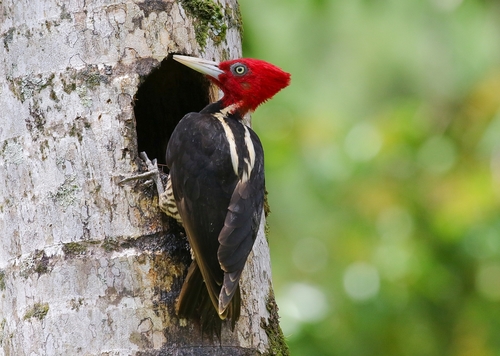
For the nominate subspecies, both sexes have black upperparts from the nape to the rump. They have vertical white or buffy white stripes along the sides of the neck that continue onto the back, nearly or fully forming a "V" shape.
Tail Structure and Color
Their tail is dull brown, with dull olive-brown coloring on the underside of the outer tail feathers.
Wing Coloration
Their wings are black except for the outer primaries; the upper surface of these outer primaries has dull brown outer webs, while their underside is greenish olive-yellow.
Underpart Coloration
Their throat and upper breast are black, and the rest of their underparts are light yellowish buff marked with narrow black bars.
Soft Part Morphology
Their bill is a long, chisel-shaped ivory yellow, their iris is light cream-buff, and their legs are greenish gray.
Adult Male Head Plumage
Adult males have a red head with a bushy crest, and sometimes a grayish brown spot on the ear coverts.
Adult Female Head Plumage
Adult females have black coloring on the forecrown, center of the crown, foreneck, and throat.
Juvenile Plumage
Juveniles resemble adult females, but have a darker bill and mostly dull black coloring on the sides of the head.
Subspecies C. g. nelsoni Traits
Subspecies C. g. nelsoni is slightly smaller than the nominate. Its black areas are browner, the upperpart stripes are whiter, and it often has brown and black barring on the lower back and rump.
Subspecies C. g. regius Traits
Subspecies C. g. regius is larger than the nominate, but otherwise similar in appearance.
Subspecies Distribution
Pale-billed woodpecker subspecies are distributed across different regions of Central America and southern North America: C. g. regius is found in eastern Mexico, between Tamaulipas and Veracruz; C. g. nelsoni is found in western Mexico, between Sonora and Oaxaca; C. g. guatemalensis ranges from Veracruz, Chiapas, and the Yucatán Peninsula south through Belize, Guatemala, El Salvador, Honduras, Nicaragua, and Nicaragua into western Panama.
General Habitat
The pale-billed woodpecker inhabits the interior and edges of a range of forested landscapes. The landscape it occurs in most commonly is lowland tropical evergreen forest.
Pacific Slope Habitat
On the Pacific slope, which is drier than the Caribbean slope, it also lives in tropical deciduous forest and mangroves.
Montane Habitat
It occurs locally in montane evergreen forest and pine-oak forest in Honduras.
Habitat Avoidance
It avoids large expanses of deforested areas.
Elevation Range
Its elevation range varies by region: from sea level to 2,000 m (6,600 ft) in Mexico, to 1,500 m (4,900 ft) in Honduras, to 1,500 m (4,900 ft) on Costa Rica's Pacific side (but only to 1,000 m / 3,300 ft on Costa Rica's Caribbean side), and to 1,200 m (3,900 ft) in Panama.