About Caltha natans Pall.
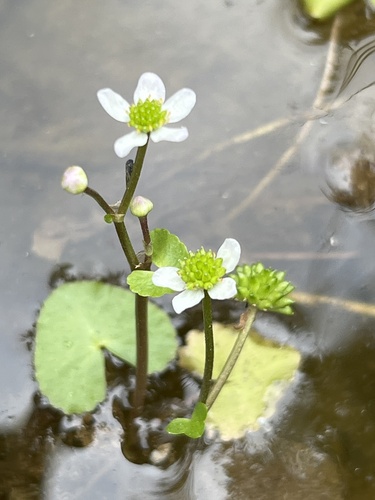
Caltha natans Pall. is an aquatic, herbaceous perennial plant pollinated by insects. Unlike other Caltha species native to North America, C. natans has very little morphological variation, and has not been split into any infraspecific taxa. This species typically grows in shallow water, producing floating leaves that can reach up to 25 millimetres (0.98 in) wide and 50 mm (2.0 in) long, borne on petioles (leaf stalks) up to 70 mm (2.8 in) long. Its flowers are approximately 5 mm (0.20 in) in diameter, with five white or pinkish sepals, and bloom from late spring between June and August. Each flower develops 20 to 55 follicles, which hold black, elliptic seeds that measure 0.5–0.8 mm (0.020–0.031 in) across.
Caltha natans has an amphi-Beringian distribution, occurring across both North America and East Asia. In Asia, it grows in Siberia, Mongolia, and the Chinese provinces of Heilongjiang and Nei Mongol. In North America, it is found in Alaska, the Canadian provinces and territories of British Columbia, the Northwest Territories, Yukon, Saskatchewan, Alberta, Manitoba, and Ontario, plus a small portion of the contiguous United States in Minnesota and Wisconsin. It is listed as a threatened species in Minnesota, and is generally rare or restricted to small, localized areas across its entire native North American range. It has only been recorded a small number of times south of the Canadian border, and many of these known locations have been lost to habitat destruction.
Caltha natans grows in shallow, slow-moving streams and creeks, and also occurs in pools, ditches, sheltered lake margins, swamps, and beaver ponds. Its stems root at the nodes in substrates of mud, silt, or clay. Populations can consist of just a few scattered individual plants, or form dense mats made up of many plants. In Minnesota, C. natans has been recorded growing alongside other species including manna grass (Glyceria spp.), sedges (Carex spp.), pondweed (Potamogeton spp.), and bladderwort (Utricularia spp.).