About Anemonastrum narcissiflorum subsp. villosissimum (DC.) Á.Löve & D.Löve
Plant Height and Basal Structure
Plants of Anemonastrum narcissiflorum subsp. villosissimum grow 7 to 60 cm (2+3⁄4 to 23+1⁄2 inches) tall from a caudex, a woody perennial base. They flower from spring to mid summer, and often continue flowering into late summer.
Basal Leaf Count and Arrangement
This taxon produces 3 to 10 basal leaves that are ternate, meaning they are arranged with three leaflets. The leaves are shaped rounded to rounded triangular, and have petioles 4 to 20 millimetres (5⁄32 to 25⁄32 inch) long.
Flower Cluster Arrangement
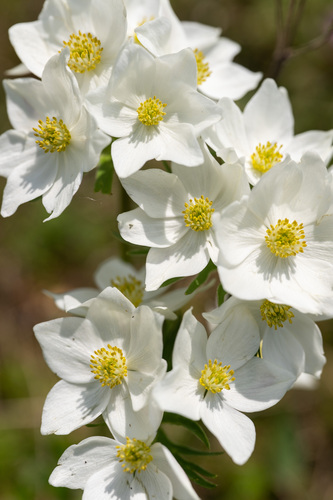
Flowers are borne in umbel clusters that hold 2 to 8 flowers, though they often appear to grow singly. The inflorescence bears 3 leaf-like bracts that resemble the basal leaves, but are simpler, much smaller in size, and pinnatifid in shape.
Flower Sepal Characteristics
Flowers have no petals; instead they have 5 to 9 petal-like sepals that can be white, blue-tinted white, or yellow. Flowers usually have 40 to 80 stamens, and can have as many as 100.
Fruit Cluster Structure
After flowering, the plants produce fruits grouped in rounded heads attached to pedicels 5 to 14 centimetres (2 to 5+1⁄2-inch) long. The fruits are called achenes; when ripe they are ellipsoid to ovate in outline, flat in shape, 5 to 9 millimetres (3⁄16 to 11⁄32 in) long and 4 to 6 millimetres (5⁄32 to 1⁄4 in) wide.
Achene Surface and Beak
The achenes are winged, hairless, and have curved or recurved beaks that are 0.8 to 1.5 millimetres (0.031 to 0.059 inch) long.
Native Range
Anemonastrum narcissiflorum is native to northwestern North America and Eurasia.
Habitat Types
It grows in high mountain alpine grasslands, thickets, grassy meadows with moist soil, tundra, open woods, along roadsides, and in pastures.