About Caltha introloba F.Muell.
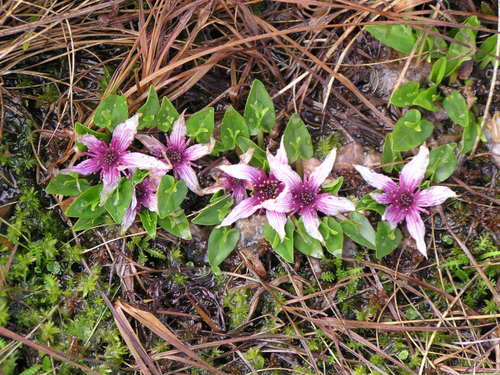
Caltha introloba F.Muell., commonly known as the alpine marsh-marigold, is a small, hairless perennial alpine herb with short, stout rhizomes that forms dense mats. Its leaves have petioles approximately 5 cm long, and leaf blades that are oblong, lanceolate, or rounded-triangular, measuring 8–40 mm long with an emarginate tip. The upper surface of each leaf bears two lanceolate-triangular appendages 4–20 mm long. The flowering stem is 1–2 cm long when flowers first open, and grows to 5–10 cm by the time seeds are ripe. It has 5 to 8 sepals 10–22 mm long, which are white but often tinged with pink or purple, especially at the base and along the veins. 15 to 30 stamens with white or often pinkish filaments and yellow pollen surround 6 to 18 free carpels. When mature, these carpels develop into spreading follicles with short beaks that contain few seeds. Flowering takes place between November and December, often directly from beneath receding snow. Caltha introloba is found in Victoria, New South Wales, and Tasmania, where it grows in alpine areas. It occurs on the slopes of Mt Kosciusko, and is locally common in sites with late-lying snow and between moss on high ranges including the Baw Baws, Snowy Range, Mt Buffalo, Bogong, and Dargo High Plains. It typically flowers at the edges of receding snow drifts. In Victoria, Caltha introloba grows alongside Brachyscome tadgellii, Carex gaudichaudiana, Carpha nivicola, Drosera arcturi, Oreobolus distichus, and Schoenus calyptratus. Flower buds begin developing in mid-January, the middle of the southern hemisphere summer, and are fully formed by May, when fresh snow no longer melts. Most flowers open after snow melts in October, though some flowers will open under persistent snow cover if it lasts until mid-November. Seeds are typically fully developed by the end of summer, in February. Experiments have shown that flower formation is triggered by long days and strong light. Flowers will only open after a cold period, which is likely a mechanism to prevent premature opening in autumn. Seeds of Caltha introloba germinate best at temperatures between 22 and 27 °C, after a delay of 40–60 days, and hardly germinate at temperatures between 0 and 15 °C. After four months at 1–2 °C, however, germination below 15 °C is much faster and more successful. This means seeds shed in summer are unlikely to germinate before snow melts the following spring. Growth and photosynthesis are optimal around 15 °C, which is near the mean maximum summer temperature in the alpine conditions where this species grows. Photosynthesis also occurs at 0 °C, so the growing season likely includes the entire period when plants are not covered by snow.