About Thalictrum thalictroides (L.) A.J.Eames & B.Boivin
Scientific Nomenclature and Basal Morphology
Thalictrum thalictroides (L.) A.J.Eames & B.Boivin is a hairless plant that grows from a cluster of tuberous roots. It produces upright stems 10 to 30 cm (4 to 12 in) tall, each of which terminates in flowers.
Basal Leaf Structure
Basal leaves have 10–30 cm (4–12 in) long petioles (leaf stalks), and their leaf blades are two times ternately compound. Leaflets are broadly rounded in shape, with three lobes at their ends.
Flowering Period and Inflorescence Arrangement
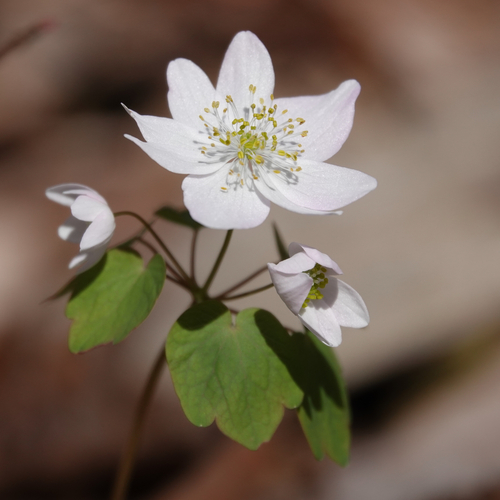
This species flowers in spring; flowers are borne either singly or in umbel-like inflorescences holding 3 to 6 flowers. Short stems hold fully opened flowers above the plant's foliage.
Involucral Bract Characteristics
Involucral bracts have three leaflets, similar to the plant's main leaves.
Flower Morphology
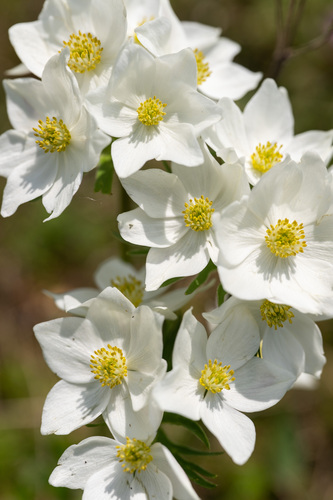
The showy, rounded flowers have a cup of 5 to 10 white to pinkish-lilac petal-like sepals, with many yellow stamens in the center surrounding 4-15 carpels. The sepals measure about 5 to 18 mm (3⁄16 to 11⁄16 in) long, and the stamens' filaments measure 3–4 mm (1⁄8–3⁄16 in) long.
Fruit Development and Morphology
In late spring, the plant releases ovoid to fusiform achenes (fruits) that are 3 to 4.5 mm (1⁄8 to 3⁄16 in) long. When immature, the achenes are green and have 8 to 10 prominent veins; they turn dark brown when ripe.
Etymology of Specific Epithet
The Latin specific epithet thalictroides refers to this plant's leaves, which resemble leaves of meadow rue.
Habitat Preferences
This species typically grows on banks and in thickets within low-lying deciduous woodland, at elevations between 0 and 300 m (0–984 ft).
Distribution Range
Its main distribution covers the northeastern United States and Ontario, Canada.