About Callionymus lyra Linnaeus, 1758
Head and Jaw Structure
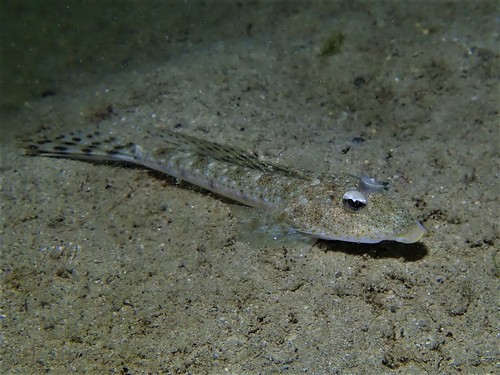
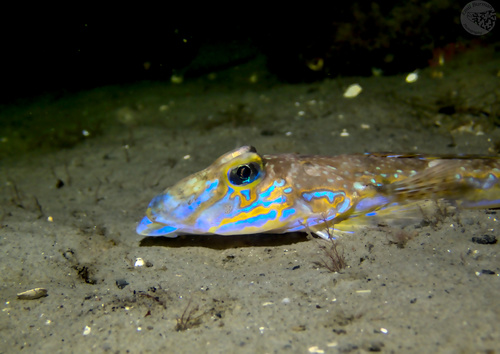
The common dragonet, scientific name Callionymus lyra Linnaeus, 1758, has a broad, triangular, flattened head, a long snout, and a protruding lower jaw.
Body and Tail Shape
Its body is also flattened, but its tail is rounded.
Eye and Gill Placement
The eyes sit on the top of the head, and the gills are located on the upper part of the body.
Preopercular Bone Features
The preopercular bone is strongly hooked and bears four robust spines: the front spine points forwards, while the other three face rearwards.
Sexual Dimorphism in Fins
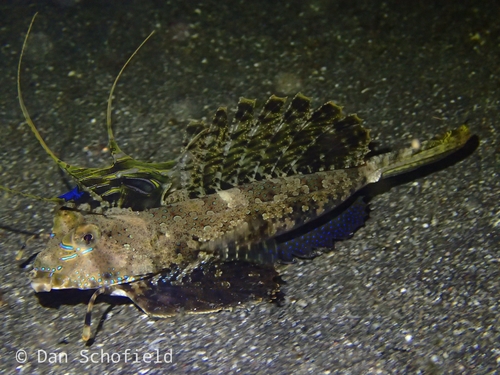
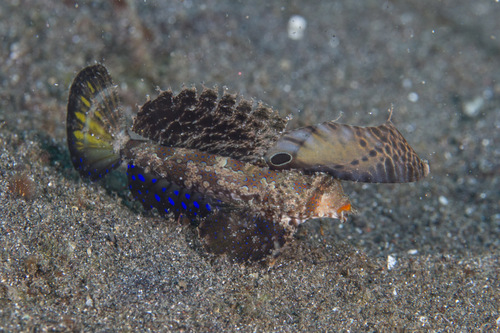
Adults are sexually dimorphic: mature males have elongated rays in their dorsal and caudal fins.
Mature Male Coloration
Males have a yellowish second dorsal fin marked with bright blue longitudinal stripes, plus bright blue markings on the head and body.
Female and Immature Male Coloration
Females and immature males are brown, paler on the underside, with a series of six brown blotches along their flanks. Three symmetrical brown saddle-shaped blotches run along the back, and the second dorsal fin has indistinct darker longitudinal stripes.
Size
Females are normally smaller than males, with an average total length of 20 centimetres (7.9 in), while larger males can grow up to 30 centimetres (12 in).
Camouflage
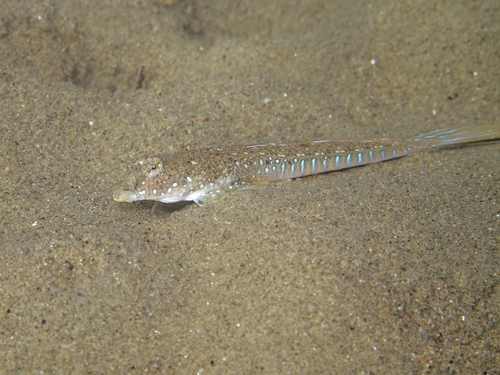
Their coloration and patterning provide effective camouflage on coarse sand or gravel substrates.
Seabed Resting Behavior
When resting on the seabed, their fins are often folded.
Atlantic Distribution
Common dragonets are found in inshore waters of the eastern North Atlantic, ranging north from Iceland and Norway along Europe's western coasts to Mauritania.
Additional Range Locations
They also inhabit the island groups of the Faroes, British Isles, Canary Islands, Madeira, and Azores, and occur throughout the Mediterranean Sea and Black Sea.
Depth Range
The common dragonet is a demersal species that occurs from the sublittoral zone down to depths of up to 430 metres (1,410 ft), and is most frequently found between 5 metres (16 ft) and 50 metres (160 ft).
Habitat Temperature
It lives in temperate waters with water temperatures of 16–20 °C (61–68 °F).
Substrate Burrowing Behavior
It spends most of its time on the seabed, partially buried in sand or shell gravel. When buried in substrate, only its head and eyes protrude, and it can emerge quickly to feed.
Diet Composition
It is an opportunistic feeder that preys on the most abundant suitable prey available, feeding mostly on small invertebrates such as worms and crustaceans. In one study, crustaceans made up over 85% of the identifiable diet, with the porcelain crab Pisidia longicornis accounting for 43% of the diet.
Additional Prey Items
Molluscs, especially cockles, are also preyed on by common dragonets.
Predators
In the Irish Sea, common dragonets are an important prey item for Atlantic cod and pouting.
Male Territoriality
Males are territorial and aggressively defend their territories from other males.
Spawning Mode
Unlike many pelagic spawning fish species, common dragonets spawn in pairs.
Courtship Display
They engage in an elaborate courtship: the male approaches the female, spreading his pectoral fins, erecting both dorsal fins to display his colors, while repeatedly raising his head and opening his mouth very wide.
Spawning Ascent
If the female responds to this display, the male becomes more excited, and eventually the pair swims vertically toward the surface, with the female resting on the male's pectoral fins.
Fertilization Process
At the surface, eggs and milt are released between their bodies for fertilization. After fertilization, the eggs drift away in the current.
Life Stage Habitats
Common dragonet eggs, larvae, and postlarvae are pelagic, while juveniles prefer the intertidal zone.
Human Relevance
This species is of minor importance to local commercial fisheries, and may be displayed in public aquariums.