About Calliandra eriophylla Benth.
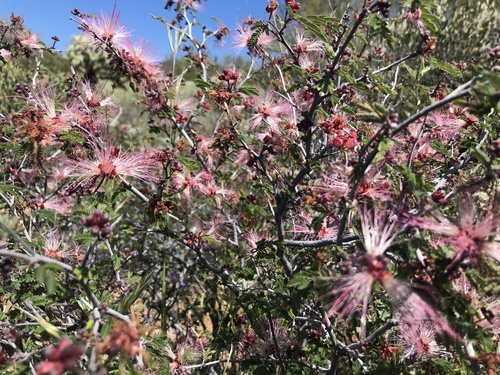
Calliandra eriophylla Benth. is a species in the Calliandra genus, which contains over 250 total species, only three of which are native to the southwestern North America. Its common name, fairy duster, refers to its striking, showy appearance. This species thrives in high heat, and once established, it can tolerate extreme drought, surviving with watering as little as once or twice per week. Fairy duster is typically a low-growing shrub with loose branching. At higher elevations, it grows in a prostrate form, while at lower elevations it grows upright and bushy. Mature plants can reach 4 to 5 feet tall and twice as wide; 1 to 3 feet tall and 2 to 4 feet (60 to 120 cm) wide is also common. Pruning is not required for this plant, but pruning will encourage it to grow much denser. It produces spherical flower clusters 1 1/4 to 2 inches in diameter, colored cream, pink, or white. These clusters are made up of many individual flowers with long, slender stamens, which are usually straight but occasionally curled. It blooms in spring and summer, producing flowers ranging from pale to vibrant pink. Fairy duster grows in dry areas, and can survive with little water and varying levels of sun exposure, though it blooms more heavily in full sun. It requires naturally alkaline, gravelly, dry soil, and is most often found on open hillsides, desert slopes, and desert washes below 5,000 feet (1,500 m). Its preferred growing elevation falls between 1,000 and 5,000 feet (300 and 1,500 m). Calliandra eriophylla is widely distributed across arid and dry regions of the Southwestern United States and Northern Mexico. In the United States, it is native to southern California, New Mexico, Texas, and Arizona, and is found in the Mojave and Sonoran deserts as well as the Sonoran and Chihuahuan deserts of Northern Mexico. This species is common in southwestern United States deserts, and hosts a variety of pollinators. Its primary pollinators are bees, flies, butterflies, and hummingbirds, which it attracts by producing a large amount of nectar equal to roughly 2.17 mg of sugar per flower. After pollination, dehiscent seed pods develop. When the seeds reach maturity, the pods break open and launch the seeds to propagate the plant. A major threat to this species' seeds is consumption by animals before development; small birds such as quail will even pry open unopened mature pods to eat the seeds inside.