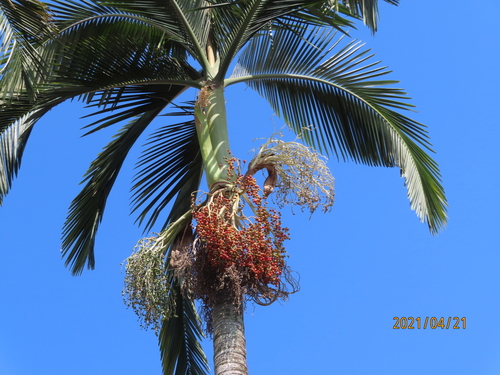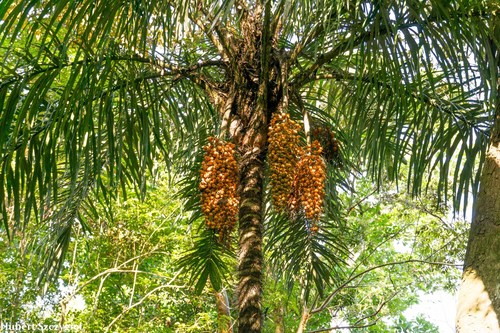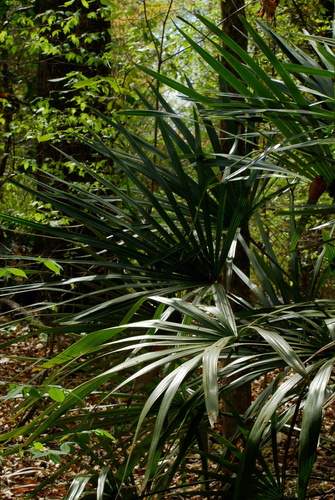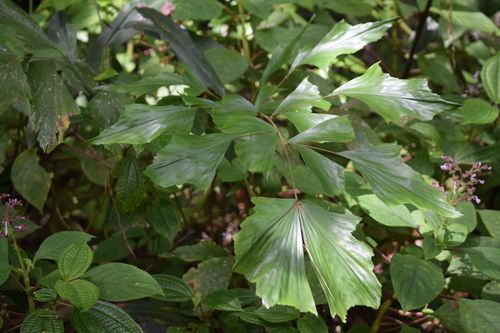
About Calamus caryotoides A.Cunn. ex Mart.
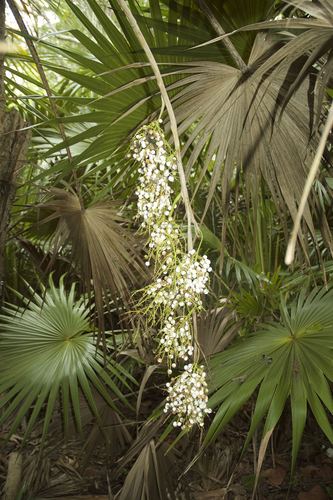
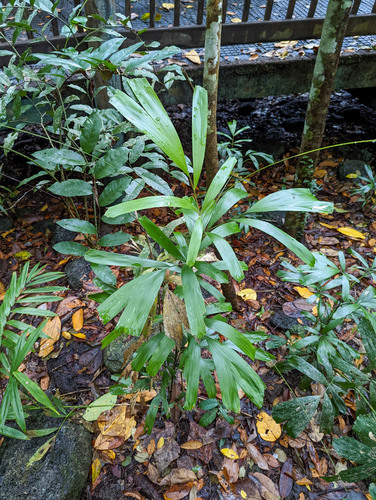
Calamus caryotoides A.Cunn. ex Mart. produces a slender, flexible stem that can reach up to 2 cm (0.8 in) in diameter and 15 m (49 ft) in length. Older stem sections, from which leaves have already fallen, are green and smooth. Leaf sheathes reach approximately 15 cm (5.9 in) in length, and are covered in numerous dark spines up to 1 cm (0.4 in) long. A barbed tendril grows from the leaf sheath on the side opposite the petiole. Its leaves are roughly 40 cm (16 in) long, and are compound, meaning they are divided into smaller leaflets. Both the leaf rachis and leaflets bear small barbs. Leaflets are about 16 cm (6.3 in) long and 3 cm (1.2 in) wide at their distal end, and become quite narrow where they connect to the rachis. The distal end of the leaflet is praemorse, meaning it has a fish-tail shape. The inflorescence is pendulous and branched, growing up to 2.5 m (8 ft 2 in) long, and each inflorescence holds only male or only female flowers. The fruit is small and round, measuring around 10 mm (0.4 in) in diameter. Its outer covering is made of numerous slightly overlapping scales arranged like snake skin. Under the scales, a small amount of soft pulp surrounds a single globose seed that is roughly 8 mm (0.3 in) in diameter. This species, commonly called fish-tail lawyer cane, is distributed from near the northern tip of Cape York Peninsula, south along coastal regions to around Mount Elliott near Townsville. It grows in rainforest, gallery forest, and drier forest types, at altitudes ranging from near sea level to roughly 1,500 m (4,900 ft). The Kuku Yalanji people of the Mossman area primarily used this plant for basket weaving. According to records from the Cairns Botanical Gardens, the Yidinydji, Yirrganyydji, Djabuganydji, and Gungganyji peoples use this plant in the following ways: the thin flexible trunks of this climbing palm (along with other climbing palms) make ideal building frames, and can be split to make rope and string. Young shoots of the plant are eaten to cure headaches. Yidinydji peoples know this species as Bugul, pronounced BOOK-KOOL.