About Caladenia transitoria D.L.Jones
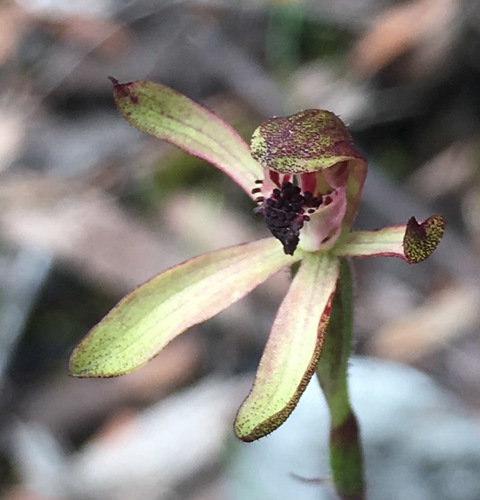
Caladenia transitoria is a terrestrial, perennial, deciduous herb that grows from an underground tuber, and usually occurs in loose groups. It produces a single erect, hairy leaf that is 60–100 mm long and 1.5–2.5 mm wide, with a slightly reddish base. One or two short-lived greenish-yellow flowers, around 20 mm wide, are borne on a stalk that is 80–160 mm tall. The outer surfaces of the sepals and petals are covered in brownish or purplish glands. The dorsal sepal is 7–11 mm long and 2–3 mm wide, curving forward to form a cap over the column. The lateral sepals are similar in size to the dorsal sepal, but are held horizontally and spread apart from each other. The petals are 7–10 mm long and around 2 mm wide, spreading either horizontally or upwards. The labellum is 5–6 mm long and around 4 mm wide, whitish in color with reddish-purple bars. The lateral lobes of the labellum are erect and surround the column, while the central part has four to six short, purplish-black teeth on each side. The tip of the labellum curves downward, and four rows of dark purple, stalked calli run along the labellum's mid-line. Flowering occurs between October and November; individual flowers only last one or two days, and flowers are sometimes self-pollinating. Commonly called green caps, this orchid is widespread but uncommon. It occurs in the Blue Mountains and coastal districts of New South Wales, eastern Victoria, and Tasmania, where it grows in shrubland, woodland, and forest.