About Caladenia major (R.Br.) Rchb.f.
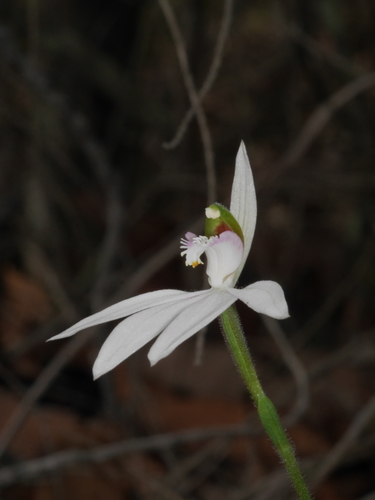
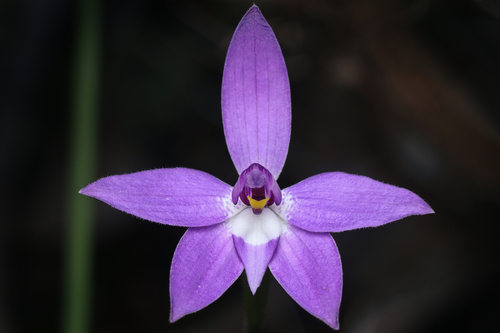
Caladenia major (R.Br.) Rchb.f., also known as Glossodia major or waxlip orchid, is a terrestrial, perennial, deciduous herbaceous plant that grows from an underground tuber. It produces a single dark green, hairy leaf that is oblong to lance-shaped, measuring 30–60 mm (1–2 in) long and 15–20 mm (0.6–0.8 in) wide. One or two faintly fragrant flowers, 30–45 mm (1–2 in) long and wide, are borne on a spike that reaches 80–350 mm (3–10 in) tall. The sepals and petals are typically purple to mauve, with white bases marked by purple spots; all-white flowers occur rarely. The dorsal sepal is 18–25 mm (0.7–1 in) long and 6–8 mm (0.2–0.3 in) wide. The lateral sepals are 18–25 mm (0.7–1 in) long and 7–10 mm (0.3–0.4 in) wide, and spread apart from each other. The petals are 16–20 mm (0.6–0.8 in) long and 5–7 mm (0.2–0.3 in) wide, and spread widely. The labellum is 7–10 mm (0.3–0.4 in) long and 5–7 mm (0.2–0.3 in) wide, white with a purple tip, and has a furrow along its midline. At the base of the labellum there is a purple, cylinder-shaped appendage with two yellow, fleshy lobes at its top. Flowering occurs from August to November. This orchid occurs in all Australian states except Western Australia and the Northern Territory. In New South Wales it is widespread and common in the eastern half of the state; in Victoria it is also widespread and common in most areas with suitable habitat; in South Australia it is common in the south-east, sometimes forming extensive colonies; in Tasmania it is widespread and common; and in Queensland it grows in the south-east of the state. It can be found in a range of habitats from coastal heath to woodland and dry open forest.