About Caladenia congesta R.Br.
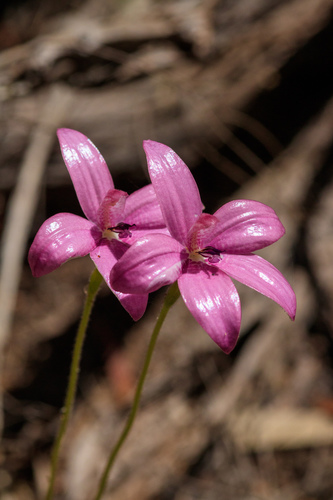
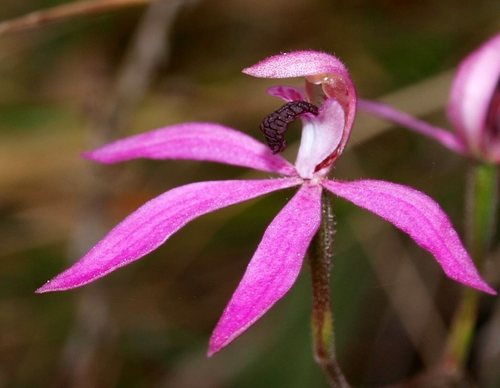
Caladenia congesta R.Br. is a terrestrial, perennial, deciduous herb that grows from an underground tuber. It produces a single, sparsely hairy, linear leaf that measures 8–18 cm (3–7 in) long and 2–6 mm (0.08–0.2 in) wide. Up to three bright pink flowers grow on a flowering spike that reaches 15–60 cm (6–20 in) in height. The sepals and petals are lance-shaped and spreading, measuring 16–20 mm (0.6–0.8 in) long. They have dark red glandular hairs on their backs, and petals are narrower than sepals. The dorsal sepal curves to form a hood that covers the column. When flattened, the labellum is 8–10 mm (0.3–0.4 in) long and 5–7 mm (0.2–0.3 in) wide, and has three lobes. The mid-lobe is oblong to lance-shaped, and is completely covered by two closely spaced rows of shiny, dark crimson to black calli. The lateral lobes of the labellum are sickle-shaped, pink, and either erect or slightly spreading. Flowering takes place between October and January. Commonly called black-tongue caladenia, this orchid grows in a wide variety of habitats, ranging from forest to heath, in sandy or clay loam soil. It occurs south from Wellington, New South Wales. It is widespread but not common across Victoria, northern Tasmania, and the far south-eastern corner of South Australia.