About Prosthechea cochleata (L.) W.E.Higgins
Common Names and Basic Classification
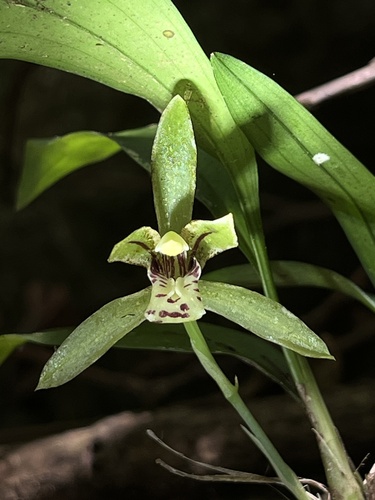
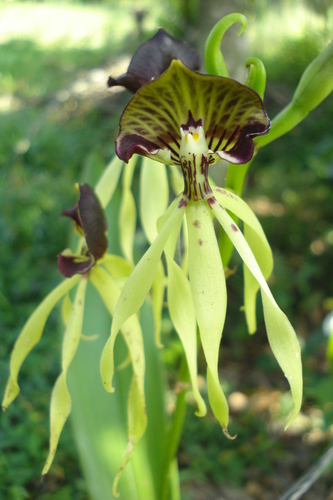
Prosthechea cochleata, commonly called the clamshell orchid or cockleshell orchid, is an epiphytic, sympodial New World orchid.
Native Range
It is native to Central America, the West Indies, Colombia, Venezuela, and southern Florida.
National Symbol Status
In Belize, it is known as the black orchid and is the country’s national flower.
Pseudobulb and Leaf Structure
Each oblong discoid pseudobulb grows one or two linear nonsucculent leaves.
Flower Structure Trait
This species has an unusual flower structure: in most orchids, the labellum typically sits below the column, but in Prosthechea species including this one, the labellum forms a "hood" over the column.
Non-resupinate Flower Definition
This makes the flower effectively upside down, a trait called non-resupinate.
Endangered Variety Description
While the main species of Prosthechea cochleata usually has one anther, Prosthechea cochleata var. triandra is an endangered variety that has three anthers and is autogamous.
Variety Survival Adaptation
This allows the variety to survive in Florida, where no appropriate pollinators for the species appear to exist.
Cultivation Value
P. cochleata is common in cultivation, and is valued for its uniquely shaped, long-lasting flowers that grow on continually growing racemes.
Hybrid Cultivars
Several hybrids have been bred with this species, including the popular Prosthechea Green Hornet, which is still often listed under the name Encyclia Green Hornet.