About Cacatua galerita (Latham, 1790)
Scientific Nomenclature and Length
Sulphur-crested cockatoos, with the scientific name Cacatua galerita (Latham, 1790), measure 44–55 cm (17.5–21.5 in) in total length.
Australian subspecies of this bird are larger than the subspecies found in New Guinea and its nearby islands.
General Plumage
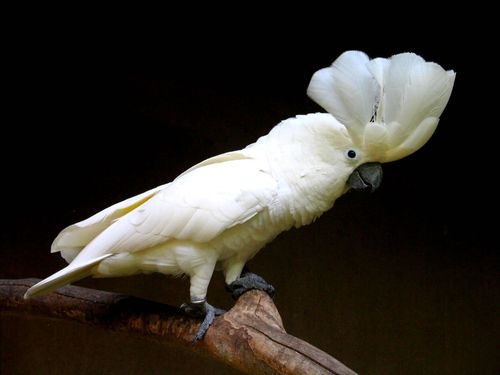
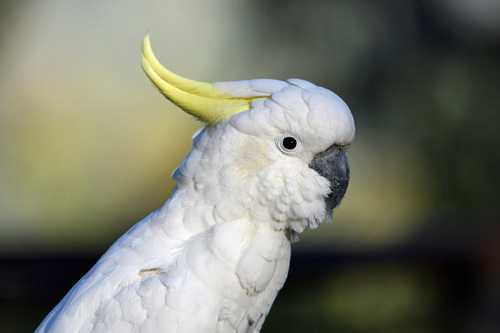
Their overall plumage is white, while the undersides of their wings and tail carry a soft yellow tinge.
Their prominent expressive crest is yellow, they have black bills, grey legs, and whitish eye-rings.
Sexual Dimorphism
Most males have almost entirely black eyes, while most females have redder or browner eyes; this difference is only visible under ideal viewing conditions.
Subspecies Variation Overview
Differences between the four recognized subspecies are subtle.
C. g. fitzroyi Traits
The subspecies C. g. fitzroyi resembles the nominate race, but lacks yellow coloration on its ear tufts and has slightly bluish skin surrounding the eye.
C. g. eleonora Traits
C. g. eleonora is similar to C. g. fitzroyi, but is smaller in size and has broader feathers in its crest.
C. g. triton Traits
C. g. triton is similar to C. g. eleonora, differing only by its smaller bill.
Similarity to Australian Corellas
This species is similar in appearance to the three corella species native to Australia, but corellas are smaller, lack this cockatoo's prominent yellow crest, and have pale bills.
Similarity to Captive Cockatoo Species
When kept in captivity, sulphur-crested cockatoos are easily confused with the smaller yellow-crested cockatoo, or with the blue-eyed cockatoo, which has a differently shaped crest and a darker blue eye-ring.
Native Range
This species is native to large areas of Australia, Indonesia, and Papua New Guinea.
Introduced Range Within Australia
Within Australia, the nominate race of sulphur-crested cockatoo has been introduced to Perth, a location far outside the species' natural native range.
Introduced Range in Singapore
Outside of Australia, the species has been introduced to Singapore, where the total introduced population is estimated to be between 500 and 2000 individuals.
Introduced Range in Palau and New Zealand
It has also been introduced to Palau and New Zealand; in New Zealand, the total introduced population is thought to number fewer than 1000 individuals.
Unconfirmed Establishment Locations
This species has also been recorded as present in Hawaii and on various islands in Wallacea, such as the Kai Islands and Ambon, but it is not yet confirmed that the species has become permanently established in these locations.