About Bungarus caeruleus (Schneider, 1801)
Size
The common krait (Bungarus caeruleus) has an average length of 0.9 m (2 ft 11 in), and can reach a maximum length of 1.75 m (5 ft 9 in). Males grow longer than females, and have proportionately longer tails.
Head Morphology
Its head is flat, with a barely distinguishable neck. The body is cylindrical, tapering toward the short, rounded tail. Eyes are fairly small, with rounded pupils that cannot be distinguished in a living individual.
Head Scales
Head scales follow a typical arrangement, with no loreal scales; four scales line the margin of the lower lip, and the third and fourth supraocular scales contact the eye.
Body Scales
Body scales are highly glossy, arranged in 15 to 17 rows; the vertebral row of scales is distinctly enlarged and hexagonal. There are 185 to 225 ventral scales and 37 to 50 entirely intact caudal scales.
Adult Coloration
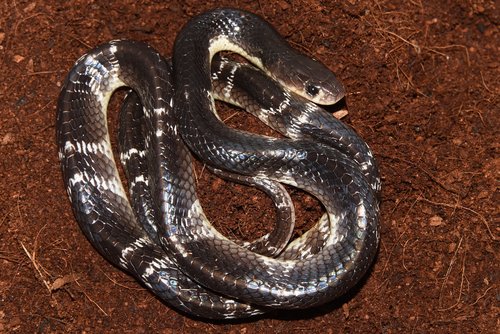
Base coloration is most often black or bluish-black, with around 40 thin white crossbars that may be unclear or absent on the front of the body. Albino specimens exist, but are extremely rare.
Age-related Color Variation
Young common kraits have a complete, clear pattern with prominent crossbars even on the front of the body; in older individuals, the narrow white lines may appear as a line of connected spots, with a noticeable spot on the vertebral region. A white spot may be present in the preocular area; the upper lips and belly are white.
Regional Distribution
The common krait is widely distributed across South Asia, found in India, Pakistan, Bangladesh, Sri Lanka, Nepal, and possibly Bhutan. Its range extends west into Afghanistan, and may reach parts of Iran.
Distribution within India
Within India, it occurs across the whole country, including the Andaman and Nicobar Islands.
Habitat Types
This snake lives in a wide variety of environments: scrub jungle, grassland, agricultural fields, semi-desert areas, rocky terrain, and suburban gardens. It is often encountered in human-modified landscapes including plantations and cultivated land.
Sheltering Sites
The common krait typically shelters in termite mounds, rat burrows, or under debris. It is strongly associated with areas near water sources such as streams, canals, and ponds.
Habitat Adaptability
The species is highly adaptable to different habitats and is common in rural areas where rodent populations are large. During the monsoon season, it often enters human homes looking for shelter or prey.
Population Status
This adaptability keeps its population overall stable despite localized threats including habitat fragmentation and human killing.
Activity Pattern
The common krait is a nocturnal species, most active at night when it hunts and moves. During the day, it stays inactive and hides in covered locations such as rodent burrows, termite mounds, or under debris. This secretive nature makes it hard to find in daylight.
Defensive Behavior
Despite having very potent venom, the common krait is generally non-aggressive and prefers to avoid conflict. When threatened, it usually coils tightly with its head tucked under its body as a defense. It may flatten its body or make sudden movements as a warning, but it rarely bites unless it is provoked.
Bite Risk
At night, however, it can become more active and aggressive if disturbed. Bites to people sleeping on the ground are commonly recorded. Researchers still debate whether these bites are defensive or predatory.
Reproductive Mode
The common krait is oviparous, meaning it lays eggs. Females lay clutches of 5 to 15 eggs in late winter or summer, in hidden spots such as leaf litter or burrows.
Parental Care and Hatchlings
Unlike many snake species, female common kraits provide parental care by guarding their eggs until they hatch, which occurs around 60 days after laying. Hatchlings are fully independent when they emerge, and are born with fully functional venom.
Male Behavior
Male common kraits are known to participate in combat displays with each other.