About Buddleja madagascariensis Lam.
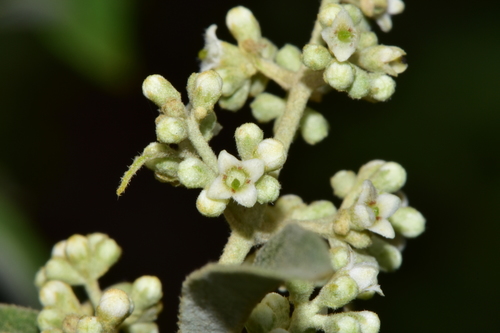
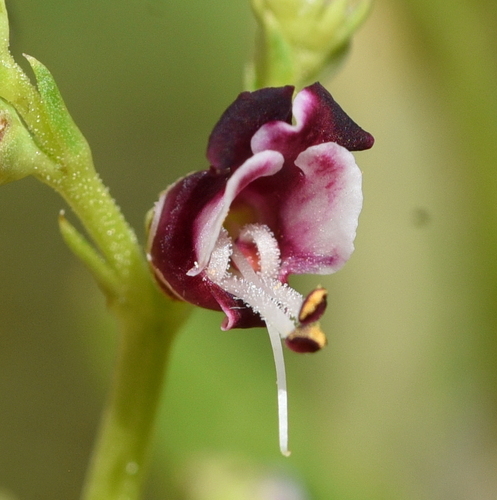
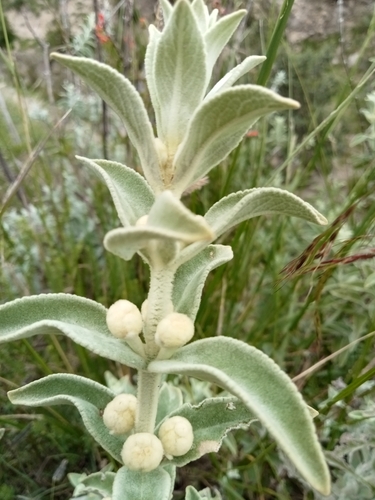
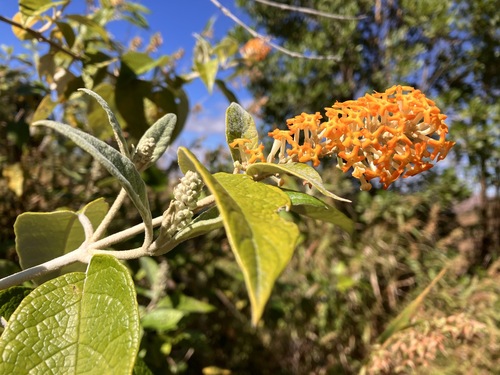
Buddleja madagascariensis Lam. is a sparse, lax shrub that reaches less than 4 meters (13 feet) in height. Its dark green leaves are arranged oppositely, are narrowly ovate in shape, grow less than 12 cm long, have petioles less than 2 cm long, feature impressed reticulate venation on their surface, and are covered in dense pubescence. The fragrant flowers of this plant form slender terminal panicles that are less than 25 centimeters (9.8 inches) long, and their colour ranges from deep yellow through orange to pink. This species is endemic to Madagascar, where it grows in scrub on mountain slopes at elevations between 600 and 2,000 metres (2,000 to 6,600 feet).
This species was first formally named and described by Lamarck in 1792, and was introduced to cultivation in 1827. In 1831, Masters listed it in his Hortus duroverni Canterbury nursery catalogue under the name B. heterophylla. Buddleja madagascariensis is cultivated as an ornamental plant. It cannot tolerate sub-zero temperatures (temperatures below 32 °F), so it can only be reliably grown outdoors in gardens with subtropical or tropical climates, such as those in Southern California and Florida in the United States. However, it can survive in temperate coastal regions when planted against south-facing walls with additional winter frost protection. In other locations, it is typically grown as a conservatory or greenhouse plant. This shrub is grown under glass as part of the NCCPG National Collection of Buddleja held by Longstock Park Nursery, near Stockbridge, Hampshire, England. Its hardiness rating is RHS H2, and it is suited for USDA zones 9 through 10. This shrub was awarded the Award of Garden Merit by the Royal Horticultural Society (record 688) in 2002.