About Brookesia superciliaris (Kuhl, 1820)
Common Name & Distinguishing Features
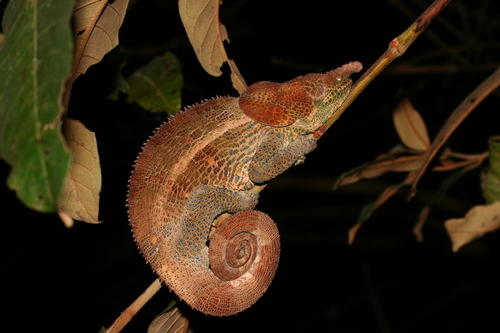
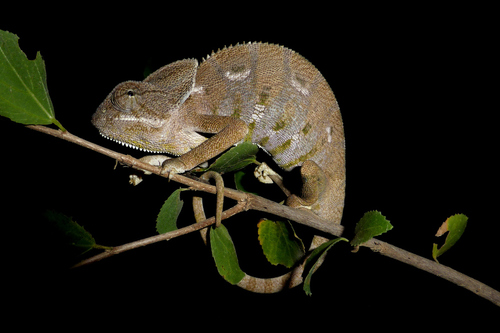
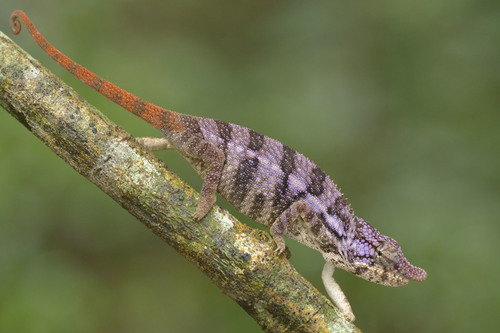
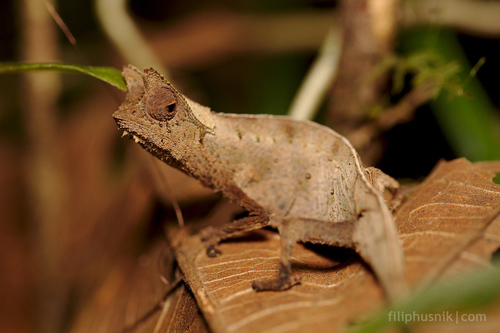
Commonly called the brown leaf chameleon, Brookesia superciliaris is distinguished by a prominent forehead, a laterally compressed body that resembles a curled dead leaf, and characteristic facial features.
Coloration & Appearance Variation
The size and appearance of this chameleon varies considerably across its wide range, and individuals may be any shade of brown, beige, grey, olive, green, or dark red, but usually display colors and patterns that mimic a dead leaf.
Head & Throat Morphology
Despite its very small size, the brown leaf chameleon has a striking appearance due to two distinct horns that protrude from the head above each eye, and four spiny scales that jut from the throat.
Geographic Range
The brown leaf chameleon is found in eastern Madagascar, including the island of Nosy Boraha, ranging from sea level up to elevations of over 1,250 metres (4,100 ft).
Habitat Preferences
It prefers the floor of evergreen primary forest, but may also occur in secondary forest and adjacent overgrown plantations.
Climbing Behavior
It favors closed-canopy forest, and climbs higher in the forest (up to 1.5 m (4.9 ft)) more often than other species in the genus Brookesia.
Foraging Behavior
The brown leaf chameleon spends its days foraging among dead leaves on the forest floor, searching for prey with its independently moving, protruding eyes and catching insects with its long, sticky tongue.
Initial Defensive Response
If threatened, the lizard’s first response is to remain still and rely on its effective camouflage, but it may also use other defensive behaviors.
Freeze-and-Roll Defense
One of these is the 'freeze-and-roll' technique: the chameleon folds its legs underneath its belly, rolls over to one side and remains very still, mimicking a dead leaf on the forest floor.
Spine Defense
Alternatively, the brown leaf chameleon may thrust its spines to ward off predators.
Courtship Ritual
Brown leaf chameleons have a distinct courtship ritual, in which a male approaches a female with marked nodding and rocking movements.
Female Mating Response
An unreceptive female repels the male with jerky movements, while a receptive female walks with the male.
Mating Process
After some time walking together, and before dusk, the male mounts the female and is carried on her back until the pair mates in the late evening or at night.
Sperm Storage
This species is known to be capable of storing sperm.
Egg Laying
Between 30 and 45 days after copulation, the female lays two to five eggs, which she hides under dead leaves, moss, and pieces of bark on the forest floor.
Nest Excavation
Sometimes, the female excavates a proper nest and lays the clutch on the ground.
Life Cycle
The eggs hatch after 59 to 70 days, and brown leaf chameleons reach sexual maturity within one year.