About Chamaeleo chamaeleon (Linnaeus, 1758)
Size
The common chameleon, Chamaeleo chamaeleon, has an average total length of 20–40 cm (8–16 inches), and females are usually substantially larger than males.
Base Coloration
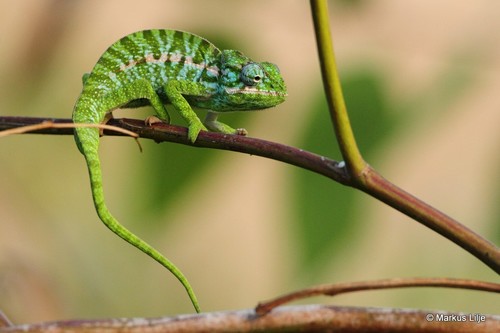
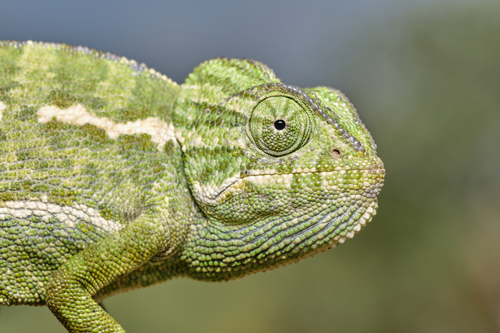
Its base body color ranges widely, from yellow/brown through green to dark brown, and it consistently has two light-colored stripes running along its side regardless of background color.
Scale Features
It has a small beard of scales, plus small hard scales along the top of its back.
Color Change Function
While many people believe chameleons change color to camouflage against their surroundings, the species actually changes color in response to light and temperature stimuli, and as an expression of emotion similar to body language.
Color Change Contexts
When captured for study, common chameleons often turn dark, and their color variation also plays an important role in intraspecific communication, particularly during the mating season.
European Native Range
In Europe, the common chameleon is naturally native only to southern Portugal, southern Spain, southern Italy, Cyprus, and the Greek island of Crete, with a small reported population also present in Apulia and Calabria in southern Italy.
Introduced Populations
It has been successfully introduced to other Greek islands, the Canary Islands, and Malta; it is thought Jesuit priests introduced it to Malta around 1880 in a small private garden in St. Julian's, and it has since thrived and spread across the island, with sightings recorded on Gozo, Malta's sister island.
Greek Population Status
In Greece, the species has disappeared from most Greek islands in recent years, and now only survives on the island of Samos, where the Archipelagos Institute of Marine Conservation carries out conservation work to protect its remaining populations.
IUCN Red List Status
The species is not currently evaluated on the IUCN Red List.
North African and Middle Eastern Range
Across North Africa and the Middle East, the common chameleon occurs in Morocco, Algeria, Tunisia, Libya, Egypt, Israel, Palestine, Jordan, Western Sahara, Saudi Arabia, Yemen, Turkey, Lebanon, Syria, Iraq, and Iran.
Social Behavior
The common chameleon is typically solitary, with individuals maintaining their own territories, and only tolerating members of the opposite sex during mating season.
Sexual Maturity and Reproduction Rate
It reaches sexual maturity within one year, and females produce one clutch of eggs each year.
Mating Dynamics
Larger females produce more eggs, and they are more attractive to males, which will fight over a receptive female.
Mating Season Timing and Behavior
The mating season runs from mid-July to mid-September, and during this time individuals move down to lower levels of vegetation or the ground to search for mates.
Egg Laying and Incubation
Females lay their eggs in soil, where the eggs take 10–12 months to incubate.
Cannibalism
Adult common chameleons, especially adult males, will eat young chameleons they encounter.