About Breviceps adspersus Peters, 1882
Common Names and General Appearance
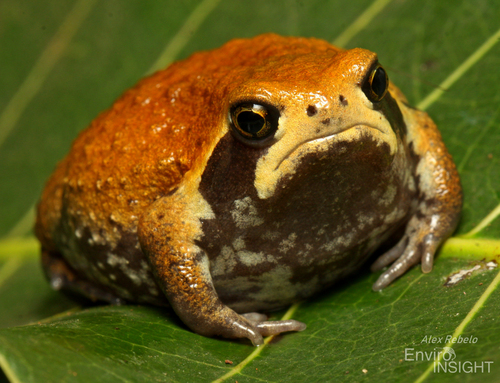
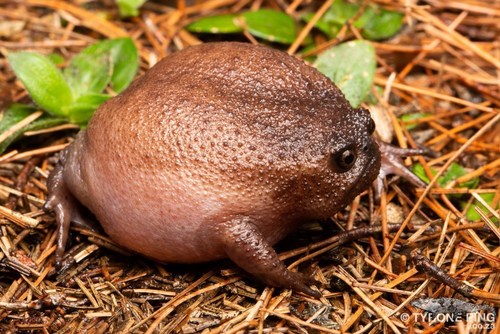
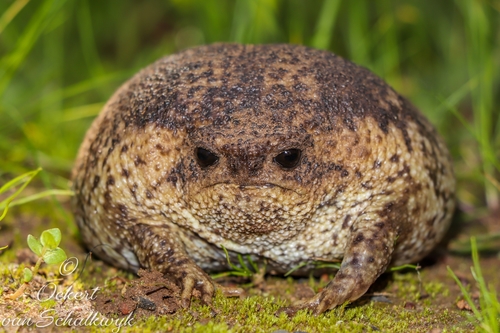
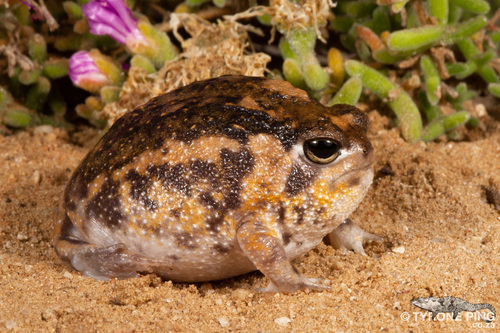
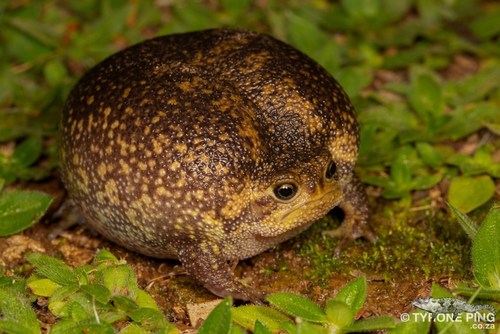
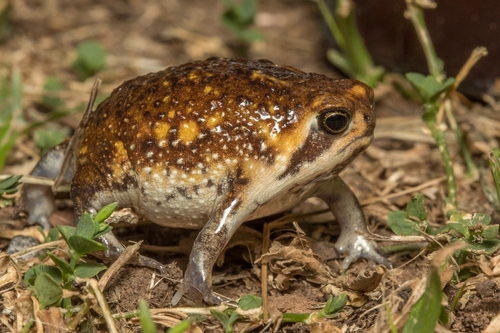
Breviceps adspersus, commonly known as the common rain frog, has a brownish-green coloration, a round body, and stumpy legs. This species cannot jump or swim.
Digging Adaptations
It has sharply rigid metatarsal tubercles, which it uses to dig deep burrows.
Sexual Dimorphism and Size
The species displays significant sexual dimorphism: males reach 30–47 mm in length, while females are typically larger, measuring 40–60 mm.
Subspecies Classification
Two recognized subspecies exist: Breviceps adspersus adspersus and Breviceps adspersus pentheri. B. a. adspersus occurs mostly in southeast Africa, while B. a. pentheri is found in southern Africa. It is not definitively confirmed that the two are separate subspecies, but they remain classified as such due to differences in coloration and markings.
Habitat
The common rain frog inhabits temperate forests and open grasslands of southeast Africa.
Activity Patterns
It spends the dry winter months inside burrows, and emerges after rain to feed and mate, usually at night.
Diet
Its diet consists of termites, ants, and other invertebrates.
Behavioral Traits
Individuals of this species also climb on one another and shed and eat their skin.
Population Status
The species has a stable population, and is described as "locally common".
Mating Adaptation
Because males are too small to grip females during mating the way most other frog species do, the male secretes a glue-like substance to hold the mating pair together.
Nesting Behavior
The attached pair burrows backwards into the soil until they reach a chamber the female dug 30 cm below the surface.
Reproductive Strategy
The female lays her eggs in this chamber, and the eggs hatch directly into froglets rather than the tadpole stage seen in many other frogs.