About Bradypus tridactylus Linnaeus, 1758
Head and Limb Morphology
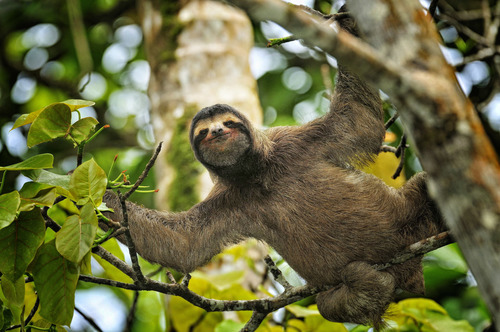
The pale-throated sloth (Bradypus tridactylus Linnaeus, 1758) has a rounded head with a blunt nose and small external ears. Its limbs are long and relatively weak, and the arms are nearly twice as long as the hindlimbs.
Digit and Claw Structure
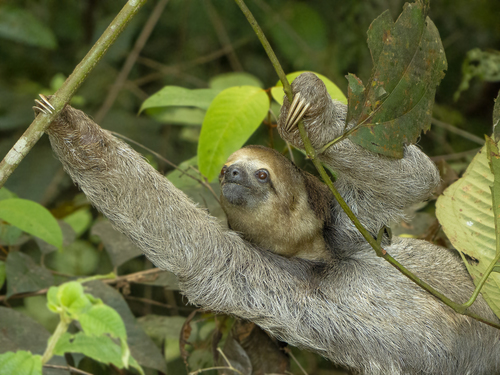
Both the hands and feet have three digits, each bearing long, arched claws, with the middle claw being the largest and strongest.
Adult Male Size
Adult males measure 45 to 55 centimetres (18 to 22 in) in head-body length, have a short 4 to 6 centimetre (1.6 to 2.4 in) tail, and weigh between 3.2 and 6 kilograms (7.1 to 13.2 lb).
Adult Female Size
Females are generally larger, ranging from 50 to 75 centimetres (20 to 30 in) in head-body length and weighing 3.8 to 6.5 kilograms (8.4 to 14.3 lb).
Fur Composition
The body is covered in coarse guard hairs that reach up to 10 centimetres (3.9 in) long, over a finer undercoat.
Algal Symbiosis and Camouflage
Green algae live mutualistically between the microscopic scales on the surface of the guard hairs, giving the sloth a faintly greenish appearance that acts as camouflage.
General Body Coloration
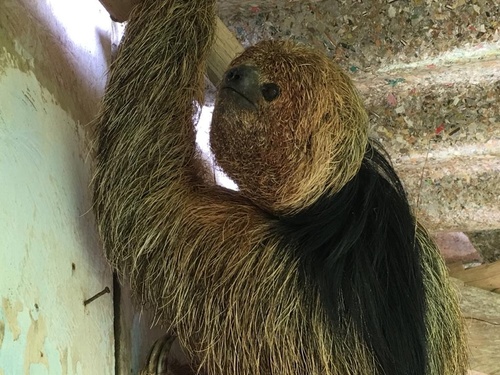
Most of the body of adult pale-throated sloths is blackish-grey, with darker patches across the back, shoulders, and hips.
Male Dorsal Marking
Males have a bright yellow or orange patch on the back, split by a central black stripe.
Distinguishing Throat Marking
Pale-throated sloths are hard to tell apart from their close relative the brown-throated sloth, but, as their common name suggests, they have a pale yellow patch on the throat.
Eye Structure and Vision
Their eyes are large and face forward to enable binocular vision, with round pupils. Unusually, they appear to have no cone cells in their retinas, which suggests the species cannot see color.
Hearing and Smell
Despite having seemingly small ears, the pale-throated sloth has excellent hearing, and it is also reported to have a good sense of smell.
Geographic Range
The pale-throated sloth is found only in the tropical forests of northern South America, spanning Guyana, Suriname, French Guiana, eastern Venezuela, and the part of Brazil that lies north of the Amazon River.
Taxonomic Status
No subspecies are currently recognised.
Mating Behavior
Mating occurs in trees, with the pair positioned either face to face, or with the male on the female's back.
Gestation and Birth
After a gestation period of around six months, the female gives birth to a single infant. Young are born already fully furred, with their eyes open.
Infant Development First Month
The young sloth clings to the mother's underside for the first month of life, by which point it weighs approximately 300 grams (10 oz).
Weaning Timeline
They start eating solid food at three weeks old, and are fully weaned at some point after the first month.
Juvenile Fur Development
Young pale-throated sloths initially have soft greyish-brown fur, which darkens and becomes rougher as they grow older.
Sexual Maturity
They reach sexual maturity at around three years of age.