About Bradypus torquatus Illiger, 1811
Pelage Coloration
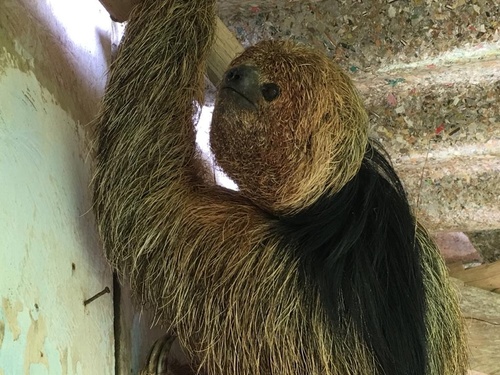
Anatomy and morphology: The maned sloth, Bradypus torquatus, has pale brown to gray outer pelage. Long coarse outer hair covers a layer of short, dense black and white underfur. Algae, mites, ticks, beetles, and moths typically live within this coarse outer coat.
Head Features
The species has a small head, with fur-covered outer ears and forward-facing eyes that are usually covered by a mask of black hair. Long hair on the sides of the face and neck covers the shorter hair on the animal's snout, and facial vibrissae are sparse.
Mane Characteristics
It gets its common name from a mane of black hair that runs down its neck and over its shoulders. The mane is typically larger and darker in males than females; in females, it may be reduced to a pair of long tufts. Apart from the mane, the fur is relatively uniform in color.
Unique Pelage Traits
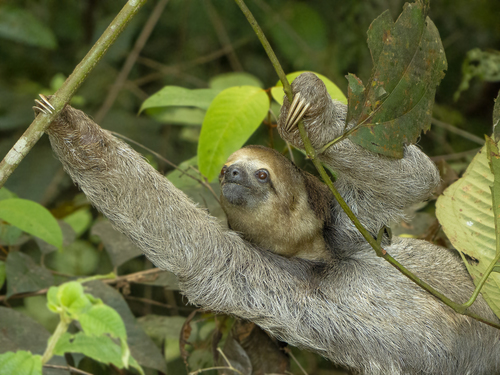
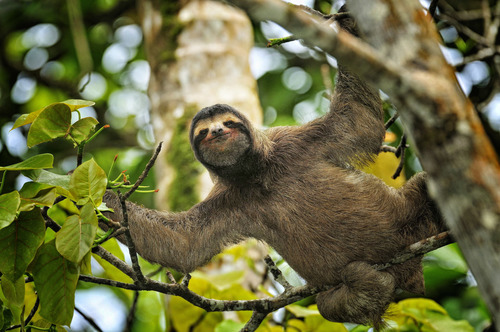
Unlike other three-fingered sloths in the genus Bradypus, this species lacks a speculum (the patch of bright fur found on the back of other sloths) and does not have black mask-like coloration around its eyes.
Male Size Measurements
Adult males have a total head-body length of 55–75 cm (22–30 in), weigh 4.5–10.1 kg (9.9–22.3 lb), and have a tail around 5 cm (2.0 in) long. Females are generally larger than males, with head-body length of 55–72 cm (22–28 in) and weight of 4.0–7.5 kg (8.8–16.5 lb).
Muscle Mass Traits
Like all sloths, maned sloths have very little muscle mass compared to other mammals of similar size. This reduced muscle mass lets them hang from thin tree branches.
Geographic Distribution
Distribution and habitat: The maned sloth is found only in the Atlantic coastal rainforest of northeastern and southeastern Brazil. It is endemic to the Brazilian states of Espírito Santo, Rio de Janeiro, and Bahia. The largest population and the greatest genetic diversity of the species are both found in Bahia.
Population Isolation
A naturally occurring valley creates a gap between the rainforests of Bahia and Espírito Santo, leaving many of the species' occupied regions extremely isolated. This isolation leads to high rates of inbreeding, which reduces genetic diversity in affected populations.
Home Range and Density
Individual maned sloths have home ranges ranging from 0.5 to 6 hectares (1.2 to 14.8 acres), and estimated population densities fall between 0.1 to 1.25 individuals per hectare (0.04 to 0.51 per acre).
Habitat Climate Requirements
This species typically lives in wet tropical forests with hot, humid climates, a very short dry season, and annual rainfall of at least 1,200 mm (47 in). In its native Atlantic coastal rainforest, the wet season runs from October to April, and the dry season runs from May to September.
Forest Habitat Types
Maned sloths are most commonly found in predominantly evergreen forests, but they can also inhabit semi-deciduous and secondary forests, thanks to their ability to eat a wide range of leaf types. They choose habitats carefully, preferring more shaded areas with larger trees and avoiding more open areas.
Habitat Threats
Much of the forest the species occupies has been impacted by human-caused deforestation, and its remaining habitat is reduced to just 7% of the species' original original biome range. Deforestation and habitat loss is the main threat to the species' existence.
Breeding Seasonality
Reproduction: While some reports note that maned sloths can breed year-round, their reproduction is seasonal in most cases. Mating usually occurs between August and October, which covers the late dry season (August and September) and the start of the wet, rainy season (October).
Breeding Rationale
The warmer wet season is more favorable for pregnant mothers and infant sloths, due to their slow metabolism and inability to regulate their body temperature. Births most often occur between February and April, which falls at the end of the wet season (February and March) and the start of the dry season (April).
Reproductive Output
The inter-birth interval for female maned sloths is one year. Mothers give birth to a single young per pregnancy, which weighs around 300 grams (11 oz) at birth and does not yet have the distinctive mane seen on adults.
Offspring Development
Young maned sloths begin eating solid food at two weeks old, and are fully weaned by two to four months of age. They leave their mother between nine and eleven months of age.
Lifespan and Maturity
While their full lifespan has not been studied in detail, recorded individuals have lived at least twelve years. The average age of sexual maturity for the species is two to three years old.