About Brachyglottis huntii (F.Muell.) B.Nord.
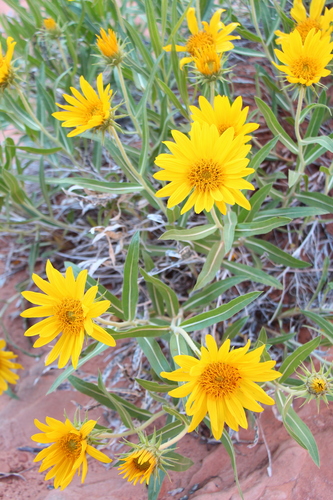
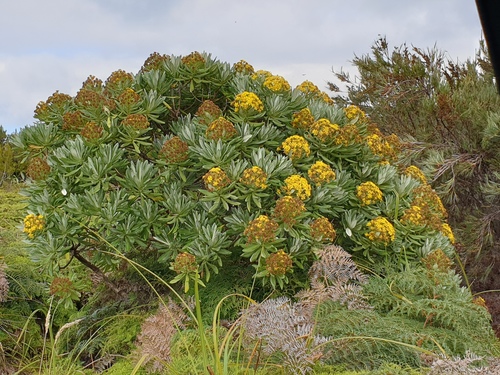
Brachyglottis huntii is a tree that can grow up to 8 meters tall. It has grey bark that flakes off into small shards when disturbed. Its branches are short, stout, and spreading, and often show multiple leaf scars. Its leaves can reach up to 12 centimeters long, have fine teeth along their upper third, and are aromatic. When young, both sides of the leaves are covered in short matted down-like hairs; these hairs give the whole plant a silvery overall hue, and leaves become relatively hairless as they age. This species blooms in summer, from November to February, and produces distinctive bright yellow flowers. It produces seeds in autumn. It contains two pyrrolizidine alkaloids: senkirkine and retrorsine, both of which are acutely toxic when eaten orally. In the past century, its distribution has been restricted to Chatham Island due to grazing pressure and habitat destruction. It is more widely distributed on Pitt Island, where grazing and feral livestock numbers are lower. Brachyglottis huntii prefers disturbed areas or areas in early ecological succession, including stream and river banks, drier swamps, open shrublands, and open ridges. It cannot survive prolonged drought or grow in heavily shaded areas.