About Brachychiton rupestris (Lindl.) Schum.
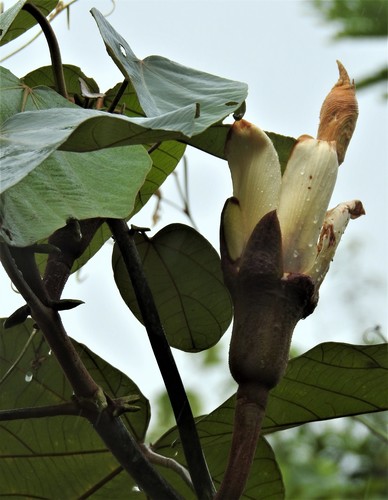
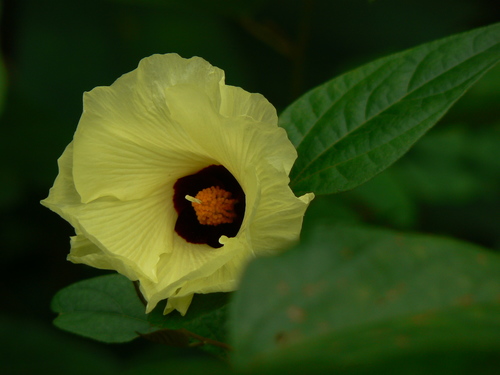
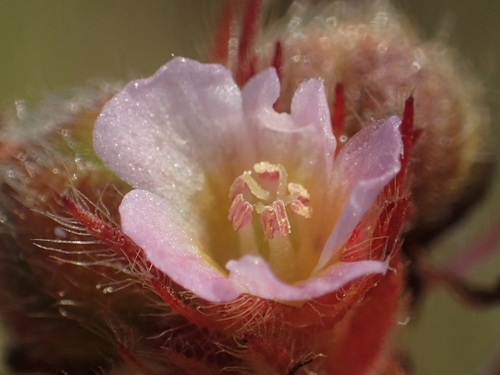
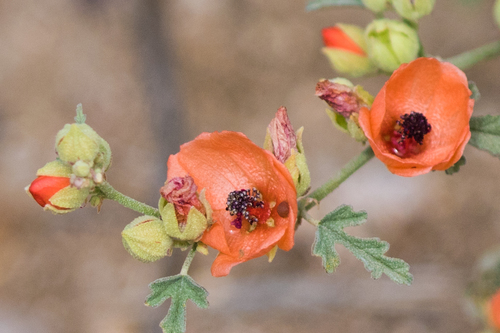
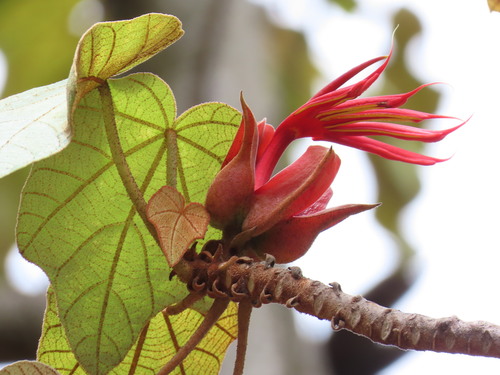
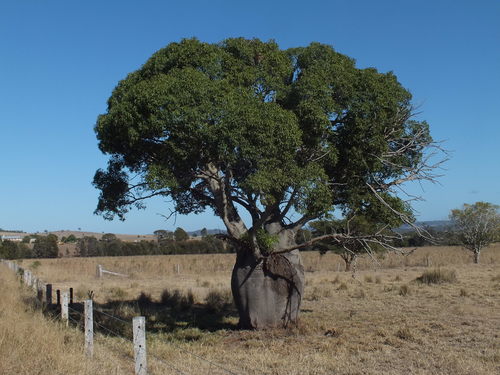
Brachychiton rupestris (Lindl.) Schum. is a succulent tree that reaches 10–20 m (33–66 ft) in height, rarely growing to 25 m (82 ft); cultivated individuals are typically shorter. Its thick trunk measures 5–15 m (16–49 ft) tall, with a 1–3.5 m (3.3–11.5 ft) diameter at breast height (DBH). The trunk has dark grey bark marked by shallow tessellation and deeper fissures. Smaller branches and the trunks of immature trees are light green or grey. As with all members of the genus Brachychiton, leaves are alternately arranged along stems, and B. rupestris is a deciduous species. In its native habitat, trees are usually leafless between September and December, though the timing, duration, and extent of leaf drop can be affected by extreme rainfall or drought, and trees sometimes drop leaves from only some branches. Leaf shape varies on every individual tree, ranging from narrow and elliptic to deeply divided. The upper leaf surface is glossy, while the undersurface is pale. Adult leaf blades are 4–11 cm (1.6–4.3 in) long and 0.8–2 cm (0.3–0.8 in) wide, with pointed acuminate or apiculate tips. They have a raised midrib on both upper and lower surfaces, with 12–25 pairs of lateral veins that are more prominent on the upper surface, emerging at 50–60 degrees from the midrib. Compound juvenile leaves have 3–9 lanceolate or linear lobes, each measuring 4–14 cm (1.6–5.5 in) long and 0.3–1 cm (0.1–0.4 in) wide. In the species' native range, panicles of creamy-yellow flowers with red markings appear from September to November, growing from axillary buds on end branches. Each panicle holds 10–30 flowers, measures 3–8 cm (1.2–3.1 in) long, and each individual flower is 0.5–1 cm (0.2–0.4 in) long and 1.3–1.8 cm (0.5–0.7 in) wide. The perianth lobes are longer than half the perianth diameter. Like all Brachychiton species, B. rupestris is monoecious: each plant has separate male and female flowers. Male flowers have 15 stamens with pale yellow anthers, while female flowers have cream or white stigmas surrounded by rudimentary star-shaped stellate carpels that sit atop the ovaries. Groups of 3 to 5 woody boat-shaped follicles, each holding 4 to 8 (and occasionally up to 12) seeds, develop from November to May. The follicles have a smooth outer surface and hairy inner surface, and split along their length to expose the seeds. The seeds are ovoid with a smooth surface, measuring 6–7 mm (0.24–0.28 in) long by 3.5–4.5 mm (0.14–0.18 in) wide, and are covered by a hairy coating called the exotesta. The closely related Proserpine bottle tree (Brachychiton compactus), found only near the town of Proserpine, can be distinguished by its more oval leaves, more compact flower heads, and longer ellipsoid follicles. The undescribed Ormeau bottle tree has brighter lime-green new growth and leaves, but is otherwise similar to the Proserpine bottle tree. Brachychiton rupestris occurs in central Queensland between 22° S and 28° S latitude; its western range limit is defined by the 500 mm rainfall isohyet. It grows on hill and ridge tops and slopes in low hilly terrain, in clay, shale, or basalt soils. It is an emergent tree in forests dominated by brigalow (Acacia harpophylla), hoop pine (Araucaria cunninghamii), or ooline (Cadellia pentastylis). It is always found in the Central semi-evergreen vine thicket of the Brigalow Belt, also known as Bottletree Scrub. Other common species in this habitat include broad-leaved bottle tree (Brachychiton australis) and belah (Casuarina cristata). In similar communities in New South Wales, B. rupestris is replaced by the kurrajong. Ecologically, B. rupestris is recorded as a host plant for the mistletoe Dendrophthoe glabrescens. Insects hosted by the species include the pale cotton stainer bug, a pest of cotton crops, and the kurrajong leaf roller caterpillar, which chews foliage and rolls individual leaves to pupate inside. Bottle tree scrub is a key habitat for the near threatened black-breasted buttonquail. B. rupestris can tolerate bushfires, and responds by producing new growth and flowering after fire. Aboriginal people used B. rupestris by eating the roots of young plants and consuming trunk secretions induced by wounding. Fibre from the species was used to make nets. The leaves are also used for fodder, and Queensland farmers often leave bottle trees standing as a potential food source when clearing land. During drought, whole trees have been cut down to feed livestock. Removing the bark exposes the soft edible pulp inside the trunk. This pulp is high in energy but low in protein, and occasional cases of nitrate poisoning have caused cattle deaths. Bottle trees are commonly planted in streets, parks, farms, and as garden features. An avenue in Roma, Queensland, was planted between 1918 and 1920, where each tree represents one of 93 local men killed in World War I. The species is also cultivated as an indoor plant and a bonsai subject. Bottle trees grow best in well-drained, slightly acidic soil in full sun, and are suited to cultivation in regional climates matching USDA hardiness zones 9 to 12. Growth is very slow in early stages, and the characteristic bottle-shaped trunk does not develop until the tree is 5 to 8 years old. Mature trees transplant easily, and can withstand up to three months between digging and replanting without harm. Trees grown from seed may take up to 20 years to flower, and flowering occurs after adult leaves have developed. Plants are easily propagated from seed. Because seeds are surrounded by irritating hairs inside the pod, care is needed during extraction. Semi-mature stem cuttings can be taken in late summer, and require rooting hormone and bottom heat to grow.