About Brachychiton acerifolius (A.Cunn. ex G.Don) F.Muell.
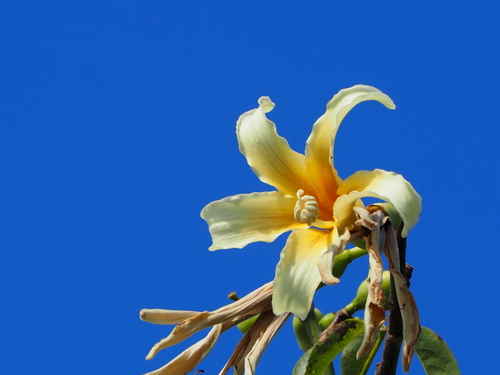
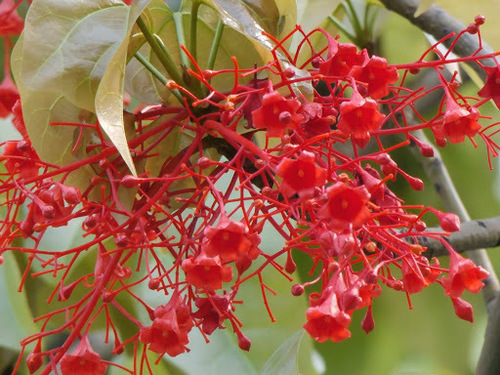
Brachychiton acerifolius (A.Cunn. ex G.Don) F.Muell. is a large deciduous tree that develops a pyramidal growth habit. In its natural habitat, it can reach 30 to 35 m (98 to 115 ft) in height, though cultivated specimens are typically shorter. The trunk is a smooth cylinder, green or grey-green in color, and often remains unbranched, tapering all the way to the tree’s tip. Its leaves have long petioles, and can grow up to 30 cm (12 in) by 25 cm (9.8 in) in size. The leaves are glossy green, hairless, simple, arranged alternately, and vary widely in shape: they can be entire and ovate, or have up to 5 lobes. The species produces bright red or scarlet flowers. Viewed from the side these flowers are bell-shaped, while viewed end-on they are star-shaped; they measure about 25 to 30 mm (1.0 to 1.2 in) long by 16 to 22 mm (0.6 to 0.9 in) wide, and grow on large panicles. Each flower has five petals, fused at the base and free at their tips. After flowering, the species forms dark brown, leathery, boat-shaped dehiscent pods, around 10 cm (3.9 in) long. In Australia, these pods ripen between May and August, splitting open along one side to reveal two rows of 12 to 26 yellow seeds. Each seed is roughly 10 by 5 mm (0.4 by 0.2 in), and is surrounded by a papery aril covered in stiff hairs that are very irritating when touched.
This tree occurs in well-developed coastal rainforests stretching from southern New South Wales to far north Queensland. On Cape York Peninsula and in northeast Queensland, it grows at altitudes ranging from sea level to 1,000 m (3,300 ft). It also grows in drier, more seasonal forest types. It acts as a host plant for the larvae of four butterfly species: the pencilled blue, shining pencil-blue, common aeroplane, and tailed emperor. Its seeds are eaten by Australian king parrots, regent bowerbirds, and satin bowerbirds.
B. acerifolius is a very popular ornamental tree, grown both in its native Australia and across the world. Its flowering is a striking display, as the tree sheds its leaves just before producing masses of bright scarlet flowers across its entire canopy. It is planted for street landscaping, in public parks and gardens, and in private gardens. It grows easily and can be propagated from seed, cuttings, or grafting. In the Northern Beaches local government area of New South Wales, the Illawarra flame tree (this species) is listed as a tree exempt from the requirement to obtain Council consent before removal. Seeds of Brachychiton species are edible; Indigenous Australians ate the seeds of this species raw or roasted after removing the irritating hairs surrounding them inside the pod. The seeds are nutritious, containing 18% protein, 25% fat, and high levels of zinc and magnesium. Indigenous Australians also ate the roots of young B. acerifolius trees.