About Bothrops erythromelas Amaral, 1923
Adult Length
Adults of Bothrops erythromelas Amaral, 1923 may reach a total length of 54 cm (21 in), including a tail that measures 6.5 cm (2.6 in) long. The species can grow to a maximum total length of approximately 0.85 m.
Dorsal Coloration
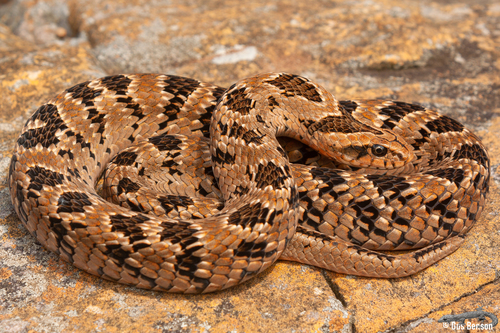
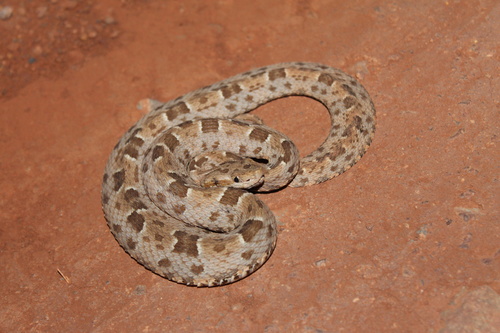
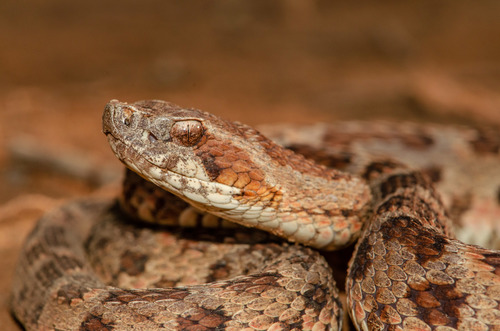
Dorsally, B. erythromelas is reddish brown, marked with a double series of black or dark brown triangular markings that may be either alternating or opposite each other. The top and sides of the head are dark brown, with additional darker markings.
Ventral Coloration
Ventrally, the snake is yellowish, speckled with brown, and has dark spots that extend from the sides of the ventral scales onto the first two dorsal rows.
Eye Features
Its eyes are moderately large, with vertically elliptical pupils.
Dorsal Scale Arrangement
The strongly keeled dorsal scales are arranged in 21 rows at midbody.
Ventral And Subcaudal Scale Counts
This species has 144 to 155 ventrals, an entire anal plate, and 33 to 35 divided subcaudals.
Activity And Habitat Use
It is mainly a terrestrial and nocturnal snake, though it will climb into low vegetation.
Defensive Behavior
Individuals tend to hide their heads when approached. The species is highly irritable, and can strike violently in response to very little provocation.
Diet
It feeds mainly on rodents and lizards.
Geographic Distribution
This snake is found in the Brazilian states of Alagoas, Bahia, Ceará, Maranhão, Minas Gerais, Paraíba, Pernambuco, Piauí, Rio Grande do Norte, and Sergipe.
Type Locality
Its type locality is "near Juazeiro, State of Bahia, Brazil".
Common Name And Habitat
This species' common name refers to its primary habitat: the Caatinga, a large ecoregion in northeastern Brazil made up of xeric shrubland and thorn forest.