About Bothrops asper (Garman, 1883)
Genus Diagnostic Head Feature
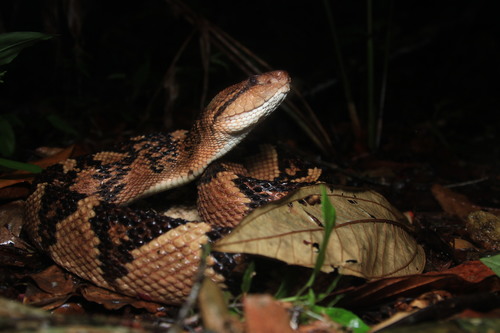
Like all species in the genus Bothrops, B. asper can be distinguished by its broad, flattened head that is clearly set apart from the rest of its body.
Head Coloration
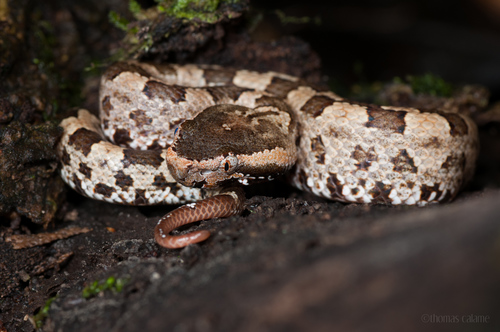
The head of this snake ranges from light to dark brown, and may even be black. Occipital blotches or streaks are usually absent, but when present they can range from indistinct to distinct.
Underside Base Color
The underside is most often pale yellow.
Dorsal and Ventral Pattern Traits
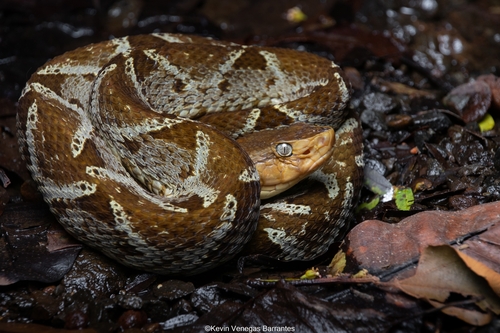
This species has different patterns and colors on its dorsal and ventral sides, and always exhibits a postorbital stripe. The ventral side can be yellow, cream, or whitish gray, with dark blotches that become more frequent closer to the posterior end.
Ventrolateral Scale Pattern
Ventrolaterally, B. asper has alternating gray scales that grow paler towards the medial line. Dark triangles with pale edges are visible on the sides, numbering between 18 and 25.
Dorsal Triangle Arrangement
The apices of these triangles either alternate or align opposite each other across the middorsal line. Dark paravertebral blotches are present in the spaces between these triangles.
Lateral Body Marking Variation
Individual specimens may have a yellow zig-zag-shaped line along each side of the body.
Dorsal Color Variation
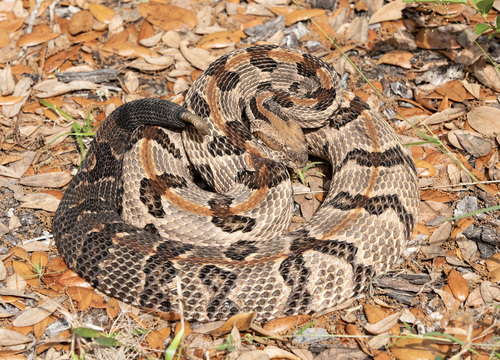
There is a great amount of color variation on the dorsal side, which can be olive, gray, light brown to dark brown, tan, or sometimes nearly black.
Dry Region Scale Adaptation
In drier regions where this species occurs, it has more scales to prevent water loss.
Typical Adult Size and Weight
Adults of this species usually measure 1.2 to 1.8 meters (3.9 to 5.9 ft) in length, and may weigh up to 6 kilograms (13 lb). Very large females can reach lengths up to 2.5 metres (8.2 ft), though this is uncommon.
Sexual Dimorphism
B. asper is among the most sexually dimorphic of all snakes. Both sexes are born at the same size, but between 7 to 12 months of age, females begin growing at a much faster rate than males.
Female Morphological Traits
Females have thick, heavy bodies and grow significantly larger than males. Relative to their body size, females also have heads two or three times the size of males, and proportionally larger fangs, which typically measure 2.5 cm.
Phenotypic Variation Across Range
Across its geographic range, this species varies greatly in phenotype. This has led to frequent confusion between B. asper and other related species, most notably Bothrops atrox, which has similar coloration but usually has yellow or rust-like tones and rectangular or trapezoidal blotches.
North and Central American Distribution
This species is found on the Gulf-Atlantic versant of eastern Mexico, ranging north to the state of Tamaulipas, and extending south through the entire Yucatán Peninsula into Central America, including Guatemala, Belize, Honduras, Nicaragua, Costa Rica and Panama. An isolated population occurs in southeastern Chiapas (Mexico) and southwestern Guatemala.
Northern South American Distribution
In northern South America, it is found in Colombia, Ecuador, Guyana and Venezuela. Its type locality is given as "Obispo, on the Isthmus of Darien" (Panama).
Altitudinal Range in Mexico and Central America
This is mostly a lowland species; in Mexico and Central America, it occurs from around sea level to 1,200 to 1,300 meters (3,900 to 4,300 ft) in altitude. In South America, it apparently reaches considerably higher elevations: up to 2,500 metres (8,200 ft) in Venezuela and at least 2,640 metres (8,660 ft) in Colombia, according to herpetologist Lancini.
Ecuadorian Range Details
According to Campbell and Lamar (2004), its range in Ecuador extends as far south along the Pacific coast as El Oro Province and the Vilcabamba area of the Río Catamayo Valley. This species is reported to occur in seven (Bolívar, Carchi, Chimborazo, Esmeraldas, Guayas, Los Ríos and Pichincha) of the fourteen provinces along the Pacific slope of Ecuador.
Peripheral Distribution Records
There are even a few records from northern coastal Peru, where these snakes have been reported in the Tumbes Region. It is also known from the island of Gorgona off the Pacific coast of Colombia.
Colombia and Venezuela Range
B. asper occurs throughout the inter-Andes valleys of Colombia, across the Caribbean coastal plain through central Venezuela north of the Orinoco, and extends as far east as the Delta Amacuro region.
Trinidad Occurrence
This is the only Bothrops species that occurs on the island of Trinidad, although the situation there is complicated by Trinidad's proximity to the Orinoco Delta, where it may be sympatric with B. atrox.
Fer-de-lance Nomenclature Confusion
There is widespread confusion and misunderstanding, particularly in popular literature, about proper nomenclature because the name "Fer-de-lance" is casually and informally applied to many species of Latin American pit vipers in the genus Bothrops. Populations of Bothrops often called Fer-de-lance on the island of Saint Lucia are actually Bothrops caribbaeus. Populations of Bothrops called Fer-de-lance on the island of Martinique are classified as Bothrops lanceolatus.
Preferred Habitat Moisture and Elevation
This species prefers moist environments, and occurs in most life zones located at low or middle elevations (up to 600 metres (2,000 ft)), excluding those with strong seasonal dry periods. However, it is sometimes found at much higher elevations, including the premontane forest in Costa Rica, the cloud forest of Guatemala and Mexico, and the lower montane wet forest in the Caribbean Region of Colombia and Ecuador.
Habitat Types
It chiefly inhabits tropical rainforest and evergreen forest, but it also occurs in drier areas of tropical deciduous forest, thorn forest and pine savannah near lakes, rivers and streams.
Home Range Size
The average home range of B. asper is between 3.71 ha and 5.95 ha, which is comparatively small relative to other pitvipers.
Reproductive Variation by Location
The timing of the reproductive cycle and litter size of this species vary by location: for example, it is more prolific in some parts of Costa Rica than in others. Reproduction is highly seasonal, and in Costa Rica, reproductive cycles are closely tied to rainfall patterns.
Breeding Timing Variation Between Lowlands
Breeding timing differs between populations in the Caribbean and Pacific lowlands. On the Pacific side, mating takes place between September and November, and females give birth between April and June.
Pacific Population Offspring Traits
The average number of offspring in this population is 18.6, with a range of five to 40. Neonates have a total length of 28 to 34.6 centimeters (11.0 to 13.6 in) and weigh 6.7 to 13.1 grams (0.24 to 0.46 oz).
Atlantic Population Reproductive Timing
On the Atlantic side, mating was observed in March, and births occur between September and November. The average number of offspring is 41.1, with a range of 14 to 86.
Atlantic Population Neonate Traits
Neonates have a total length of 27 to 36.5 centimeters (10.6 to 14.4 in) and weigh 6.1 to 20.2 grams (0.22 to 0.71 oz).
Gestation and Litter Size Correlate
In both populations, gestation lasts from six to eight months, and litter size correlates significantly with female size. This species is considered the most prolific of all snakes in the Americas.
Male Reproductive Behavior
Male-male combat has not been observed in this species. Females will mate with more than one male during mating season.
Mating Ritual
Mating involves a series of movements by the male, who then slowly chases an accepting female. The female then stops moving and adjusts her posture to allow mating.
Reproductive Frequency Uncertainty
It is not known whether this species reproduces annually or biannually.