About Bossiaea prostrata R.Br.
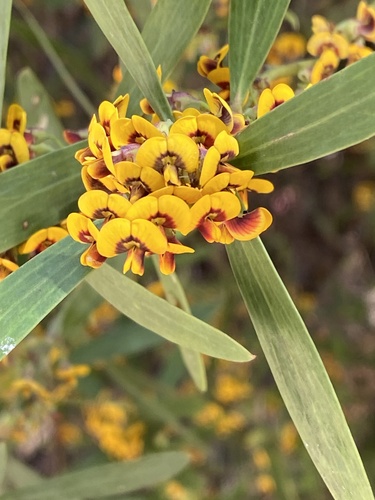
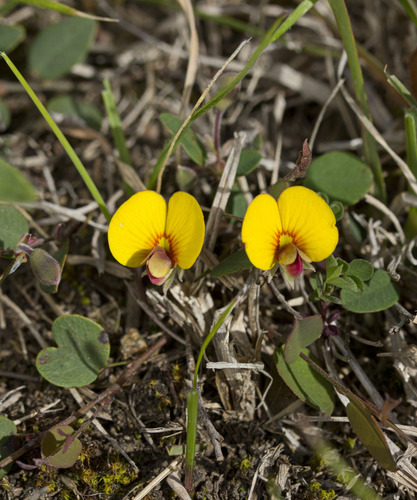
Bossiaea prostrata R.Br. is a prostrate, spreading, scrambling shrub that reaches up to 0.2 m (7.9 in) wide. Its leaves are simple and arranged alternately, with a dark green upper surface and a paler lower surface. The leaves have an ovate, rounded, or oblong shape, measuring 3–15 mm (0.12–0.59 in) long and 2–10 mm (0.079–0.394 in) wide, with a petiole approximately 5 mm (0.20 in) long. Leaves are either smooth or bear sparse hairs, with narrow to egg-shaped stipules 1–2 mm (0.039–0.079 in) long. Stems are flattened toward the apex, and are either smooth or covered in short flattened or spreading hairs. Flowers grow singly or in pairs, and are 6–12 mm (0.24–0.47 in) long. They have orange-yellow standards that are pinkish brown on the back, and purple-brown keels. The pedicels are 1–2 cm (0.39–0.79 in) long, and the bracts are 1.5 mm (0.059 in) long. The seed pods are oblong shaped, and 1.5–3.2 cm (0.59–1.26 in) long. In its native range, flowering occurs between September and November. This species is similar to Bossiaea buxifolia, but can be distinguished by its longer leaves, longer petioles and pedicels, and more widely spaced leaves. Common called creeping bossiaea, this species is found in South Australia, Victoria, Tasmania, New South Wales and Queensland, Australia. It grows in coastal heath, grassland, and open forest across a range of soils including clay-shale, and prefers wetter locations.