About Austrocallerya megasperma (F.Muell.) J.Compton & Schrire
Stem and Bark Characteristics
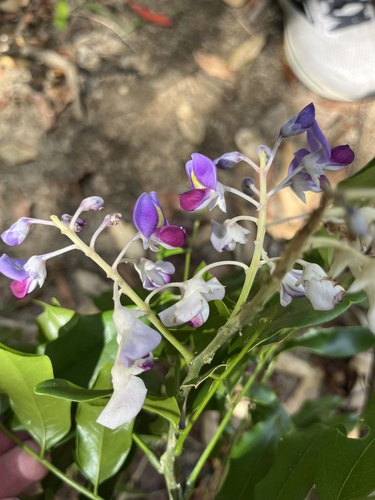
Austrocallerya megasperma is a woody climbing vine with stems that reach up to 20 metres (66 feet) in length, and its stems are covered in flaky bark.
Leaf Structure
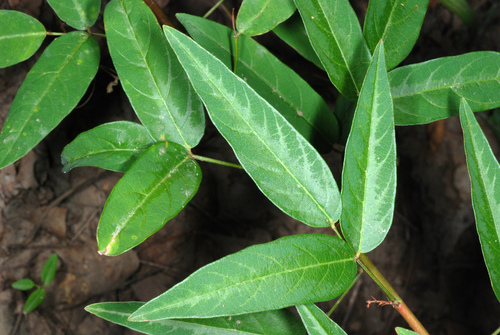
Its leaves are 15–30 centimetres (5.9–11.8 inches) long, pinnately compound, and carry 7 to 19 leaflets.
Leaflet Features
The leaflets are oblong to egg-shaped, with the narrower end at the base, and measure 4–10 centimetres (1.6–3.9 inches) long by 2–3.5 centimetres (0.79–1.38 inches) wide.
Petiole Dimensions
The entire leaf is borne on a petiole 4–6 centimetres (1.6–2.4 inches) long.
Inflorescence Structure
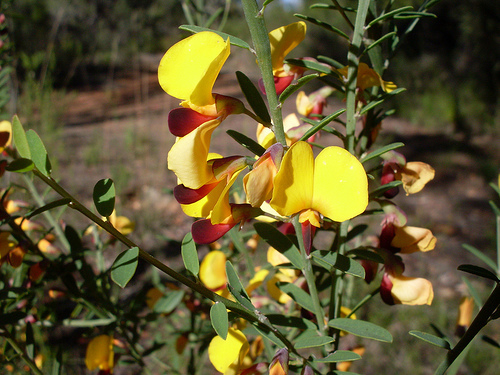
Flowers are arranged in racemes 100–250 millimetres (3.9–9.8 inches) long, with each individual flower held on a pedicel 10–20 millimetres (0.39–0.79 inches) long.
Flower Part Dimensions
The sepals are 3–5 millimetres (0.12–0.20 inches) long, and the petals are 15–20 millimetres (0.59–0.79 inches) long.
Flowering Period
Flowering takes place from July to October.
Fruit and Seed Features
The fruit is a woody, velvety pod that measures 100–180 millimetres (3.9–7.1 inches) long and 30–50 millimetres (1.2–2.0 inches) wide, containing up to four more or less oval seeds.
Distribution and Habitat
This species grows in rainforest on coastal areas and nearby inland ranges of south-eastern Queensland and north-eastern New South Wales, with its range extending south as far as the Richmond River.
Indicator Species Role
In ecological terms, this vine acts as a valuable indicator species, because it often grows alongside Aristolochia praevenosa, the birdwing butterfly vine.
Richmond Birdwing Butterfly Host Association
Aristolochia praevenosa is one of the only food plants for caterpillars of the rare Richmond birdwing butterfly, Ornithoptera richmondia.
Butterfly Larval Host Plant
Austrocallerya megasperma itself serves as a food plant for the caterpillars of two other butterfly species: the pencilled blue (Candalides absimilis) and the narrow-banded awl (Hasora khoda).
Common Name and Horticultural Use
Commonly called native wisteria, this species is grown in horticulture as an attractive garden plant.
Cultivation Requirements
However, it grows very quickly when young, requires plenty of space to develop, and needs a sturdy structure capable of supporting its weight.
Growing Conditions
It also requires well-drained growing conditions.
Cultivation in Melbourne
It has been successfully cultivated in Melbourne, where cultivated individuals took 20 years to produce their first flowers.