About Bossiaea linophylla R.Br.
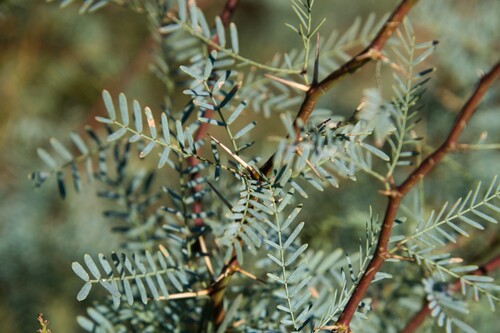
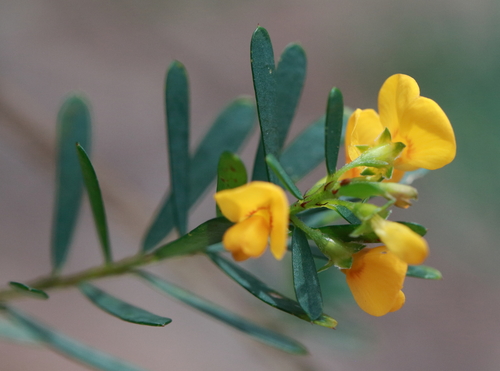
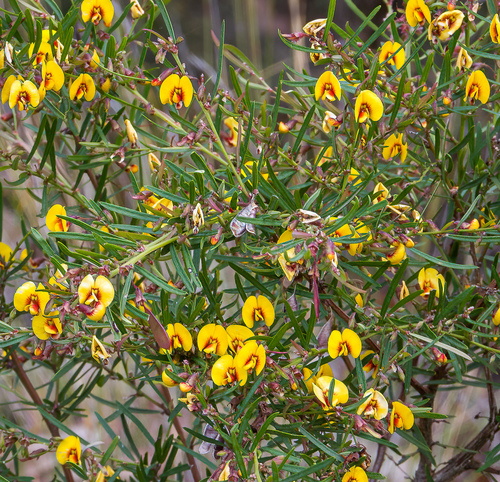
Bossiaea linophylla R.Br. is a spreading shrub that usually has a weeping habit, and typically grows to a maximum height of 3 m (9.8 ft). Its branchlets are flattened to oval in cross-section. The leaves are linear to oblong or egg-shaped, measuring 13–30 mm (0.51–1.18 in) long and 0.9–2 mm (0.035–0.079 in) wide. Each leaf sits on a petiole up to 1 mm (0.039 in) long, with tapering stipules 0.7–2.2 mm (0.028–0.087 in) long at the leaf base. Flowers are arranged singly or in small groups, with each flower borne on a thread-like pedicel 0.5–1.4 mm (0.020–0.055 in) long. Linear bracteoles 0.7–2.2 mm (0.028–0.087 in) long are attached to the pedicel. A single egg-shaped bract 0.5–1 mm (0.020–0.039 in) long is present, but it falls off during the early bud stage. The five sepals are joined at the base, forming a tube 2.0–3.2 mm (0.079–0.126 in) long. The two upper sepal lobes are 1.0–1.5 mm (0.039–0.059 in) long, and the lower sepal lobes are slightly shorter. The standard petal is bright yellow to orange or apricot with a red base, and measures 6.6–9.7 mm (0.26–0.38 in) long. The wing petals are 6.4–8.3 mm (0.25–0.33 in) long, and the keel petal is red, sometimes with a greenish base, measuring 4.8–6.4 mm (0.19–0.25 in) long. Flowering occurs from July to December. This species of Bossiaea occurs between Collie, Augusta, Albany and the Stirling Range, within the Avon Wheatbelt, Esperance Plains, Jarrah Forest, Swan Coastal Plain and Warren biogeographic regions of southwestern Australia. It grows in forest, woodland and heath, and is often the dominant understorey species in these habitats. In ecological interactions, this plant attracts the moyadong, the subspecies Platycercus icterotis icterotis of the western rosella, which eats its fruit.