About Bombax ceiba L.
Bombax ceiba L. grows to an average height of 20 meters; old individuals in wet tropical regions can reach up to 60 meters. The trunk and branches bear numerous conical spines, especially when the tree is young; these spines erode away as the tree ages. Its leaves are palmate, with around 6 leaflets radiating from a central point at the tip of the petiole. Leaflets average 7–10 centimeters wide and 13–15 centimeters long. The long, flexible petiole of the leaf can grow up to 20 centimeters long.
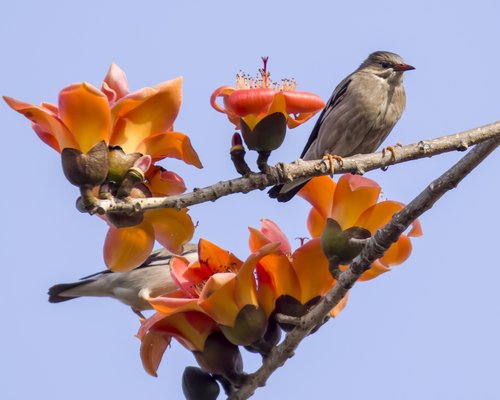
The tree produces cup-shaped flowers that grow either solitary or in clusters, located either axillary, sub-terminal, or in fascicles at or near the ends of branches. Flowers emerge when the tree is completely bare of leaves. Flowers average 7–11 centimeters wide, and can reach 14 centimeters wide. Petals can grow up to 12 centimeters long. The calyx is cup-shaped, usually with 3 lobes, and averages 3–5 centimeters in diameter. The staminal tube is short, and holds more than 60 stamens arranged in 5 bundles. The stigma is light red and can reach up to 9 centimeters long. The ovary is pink, 1.5–2 centimeters long, and its outer surface is covered in 1-millimeter-long white silky hairs.
The fruit averages 13 centimeters long. Immature fruits are light green, while mature fruits turn brown. Fruits contain numerous, long, ovoid seeds that are black or gray, packed inside white cottony fiber.
Bombax ceiba is native to Tropical Asia and Oceania, with a native range that includes Pakistan, India, Nepal, Sri Lanka, Bangladesh, Bhutan, Myanmar, South China, Taiwan, Laos, Thailand, Cambodia, Vietnam, Malaysia, Indonesia, the Philippines, the Solomon Islands, Papua New Guinea, and Australia. It is widely cultivated across southeastern Asian countries and regions, including Myanmar, Nepal, Thailand, Vietnam, Malaysia, the Philippines, Indonesia, southern China, and Taiwan. According to Chinese historical records, Zhao Tuo, king of Nam Yuet (an area covering modern southern China and northern Vietnam), gave a Bombax ceiba tree to the emperor of the Han dynasty in the 2nd century BC.
In South Asia, the tree has common regional names: Let-pan in Burmese, semal in Hindi, shimal in Nepali, shimul in Bengali, ximolu in Assamese, and sumbal in Urdu and Punjabi. It is widely planted in parks and along roadsides across India, valued for its beautiful red flowers that bloom in March and April. The species is quite common in New Delhi, though it never reaches its full 60-meter height there due to the region's semi-arid climate. The tree's cotton fibers can be seen floating on the wind in early May. In India, Bombax ceiba has two distinct growth sprints: one in spring, and another during the monsoon months. It grows in dense populations throughout Northeast India, likely due to the region's subtropical climate and heavy rainfall. In Pakistan, it occurs in eastern parts of the country, especially in the Margalla Hills and the eastern city of Lahore. In Myanmar, the flowers are left to dry, then cooked, as part of traditional Myanmar cuisine.
The tree's white fluffy fibers are carded into thread and woven into textiles in Nepal and India. In North India, the fibers are also used to fill pillows. In Thailand, the dry cores of Bombax ceiba flowers are an essential ingredient in the nam ngiao spicy noodle soup of Shan State and Northern Thai cuisine, as well as in kaeng khae curry. The 1889 book *The Useful Native Plants of Australia* records that the species was then known as Bombax malabaricum, with common names including "Simool Tree" and "Malabar Silk-cotton", and that the calyx of its flower buds was eaten as a vegetable in India.