About Boerhavia diffusa L.
Growth Form and Roots
Boerhavia diffusa L. is a creeping, perennial, much-branched herb with stout fusiform roots.
Stem and Branch Characteristics
Its branches are divaricate, and the stem is purplish and thickened at the nodes.
Leaf Morphology
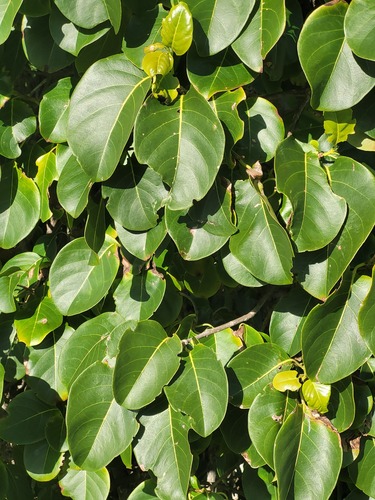
Leaves are opposite, oblique, ovate to suborbicular, rounded, with entire margins that are slightly pinkish and wavy; the lower leaf surface bears small white scales, and the leaf base is rounded.
Inflorescence Structure
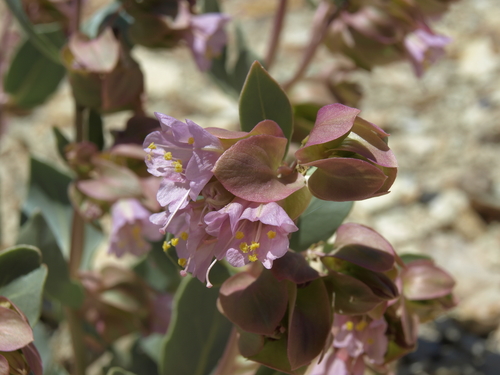
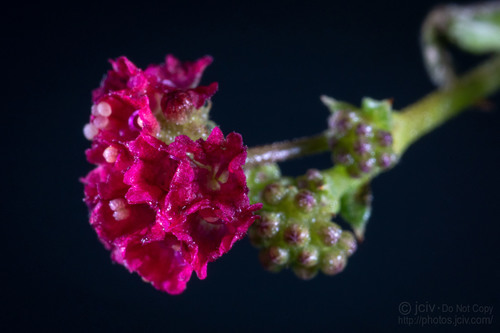
Its inflorescence consists of small umbels that form corymbose, axillary and terminal panicles.
Flower Bracteoles
Flowers have acute bracteoles.
Perianth Features
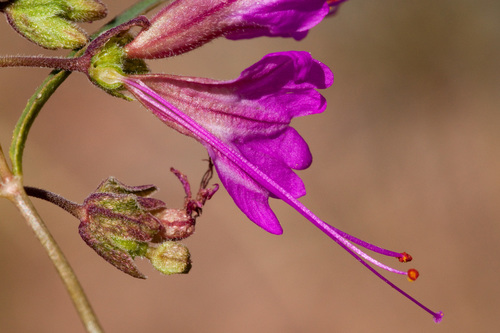
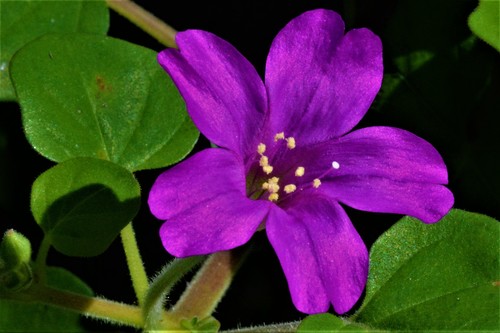
The perianth tube is constricted above the ovary, with a funnel-shaped dark pink limb that bears 5 vertical bands on the outer surface.
Stamen Characteristics
There are 2 or 3 slightly exserted, unequal stamens.
Ovary Structure
The ovary is superior and oblique, containing 1 erect ovule, and it bears a stigma.
Fruit Morphology
The fruit is a rounded, 6-ribbed achene.
Seed Features
Seeds are minute, albuminous with endosperm, and have a curved embryo.
Flower and Pollen Size
This species has small flowers, roughly 5 mm in diameter, and round pollen grains approximately 65 microns in diameter.
Fruit Dispersal Adaptation
Its small, very sticky fruits grow a few inches off the ground, positioned ideally to latch onto passing small migratory birds; this trait is thought to explain the species' very wide distribution.
Native Range Uncertainty
The exact native range of Boerhavia diffusa has not been confirmed with certainty, but the species is extremely widespread and has become naturalized in many regions.
Native Distribution in Africa
It is considered native to Africa, where it occurs in Botswana, Egypt, Eswatini, Ghana, Kenya, Liberia, Malawi, Mozambique, Namibia, Nigeria, Rwanda, Senegal, Sierra Leone, Somalia, South Africa (Eastern Cape, Gauteng, KwaZulu-Natal, Limpopo, Mpumalanga, Northern Cape provinces), Tanzania, Togo, Uganda, Zambia, and Zimbabwe.
Native Distribution in Asia and Arabian Peninsula
In Asia, it is considered native to Bangladesh, Sri Lanka, Burma, Cambodia, China (Fujian, Guangdong, Guangxi, Guizhou, Hainan, Sichuan, and Yunnan provinces), India, Indonesia, Japan (Ryukyu Islands), Laos, Malaysia, Nepal, Pakistan (Punjab, Sind, Balochistan, Gilgit Baltistan), the Philippines, Southern Taiwan, Thailand, and Vietnam, as well as the Arabian Peninsula in Oman, Saudi Arabia, the United Arab Emirates, and Yemen (Socotra).
Distribution in North America
In North America, it is found in Mexico and the United States (Florida, Georgia, South Carolina).
Distribution in the Caribbean
It also occurs across the Caribbean in Anguilla, the Bahamas, the Cayman Islands, Cuba, Dominica, Grenada, Hispaniola (Dominican Republic and Haiti), Jamaica, Montserrat, the Netherlands Antilles (Saba), Puerto Rico, Saint Lucia, Saint Vincent and the Grenadines, and both the British and U.S. Virgin Islands.
Distribution in South America
In South America it is present in Argentina, Belize, Bolivia, Chile, Costa Rica, Ecuador, French Guiana, Guatemala, Guyana, Nicaragua, Panama, Paraguay, Peru, Suriname, Uruguay, and Venezuela.
Distribution in South Pacific
It is also found in Fiji and New Caledonia in the South Pacific.
Additional Recorded Distribution
It is already recorded as occurring widely throughout India, the Pacific, and southern United States.