About Bursaria incana Lindl.
Growth Form
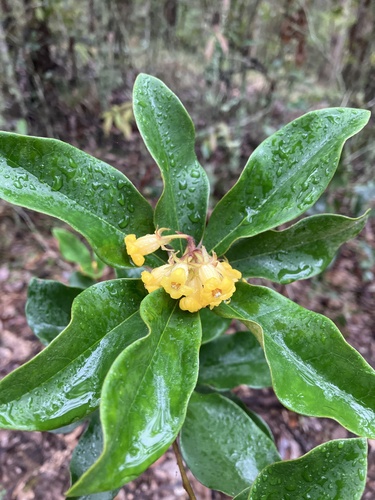
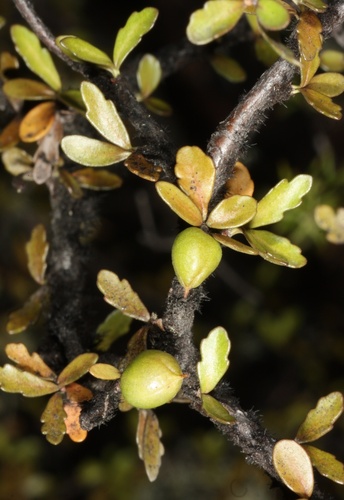
Bursaria incana is a species that typically grows as a tall shrub or sparse tree, reaching a height of 3–7 m (9.8–23.0 ft). Most of its foliage is covered in soft hairs, and its young branchlets are spiny.
Adult Leaf Shape
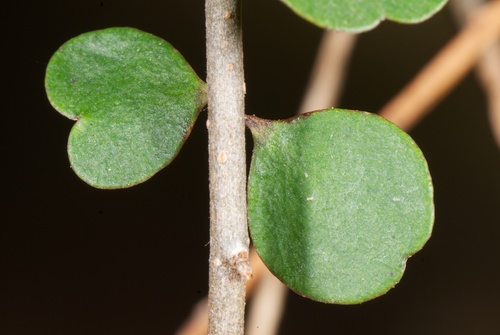
Adult leaves of this plant are heart-shaped, lance-shaped, or egg-shaped with the narrower end oriented toward the base. They measure 60–90 mm (2.4–3.5 in) long and 6–16 mm (0.24–0.63 in) wide, and grow on a petiole less than 2 mm (0.079 in) long.
Flower Arrangement
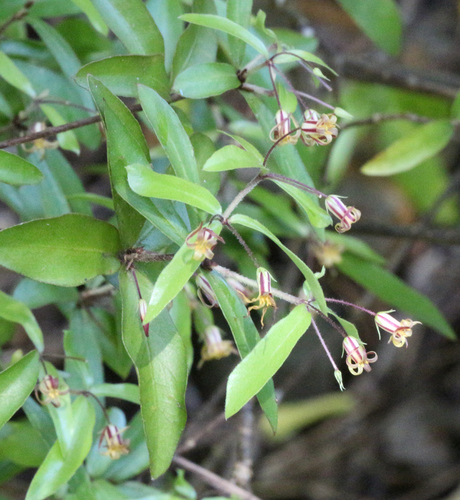
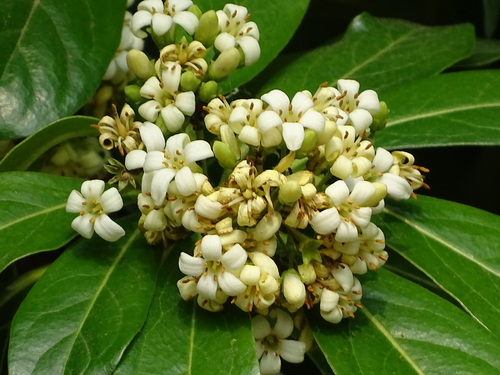
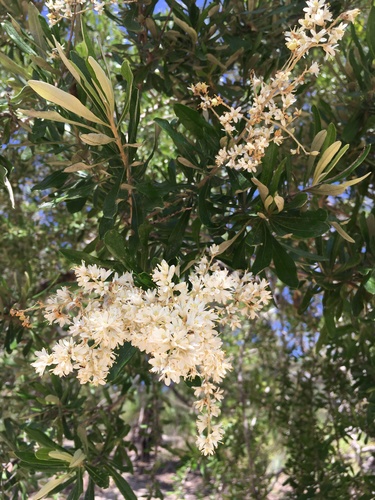
The flowers are arranged in leafy clusters, with each flower borne on a pedicel less than 2 mm (0.079 in) long.
Sepal and Petal Morphology
It has five sepals that are 1–2 mm (0.039–0.079 in) long and separate from one another, and five white petals that spread out from the base and are 6.0–7.5 mm (0.24–0.30 in) long.
Reproductive Organ Characteristics
The five stamens are separate from each other, and the pistil is densely covered in matted hairs.
Flowering Period
Flowering takes place in mid-summer, which coincides with the start of the dry season.
Fruit Characteristics
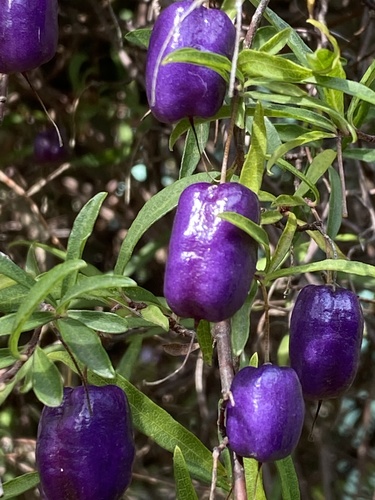
The fruit is a flattened brown capsule 8–10 mm (0.31–0.39 in) long.
Species Distribution
This species of Bursaria is distributed across most of Queensland, excluding coastal regions and the arid inland, and has isolated populations in the northern part of the Northern Territory.
Habitat
It most commonly grows in open, grassy woodland and open forest.