About Billardiera fusiformis Labill.
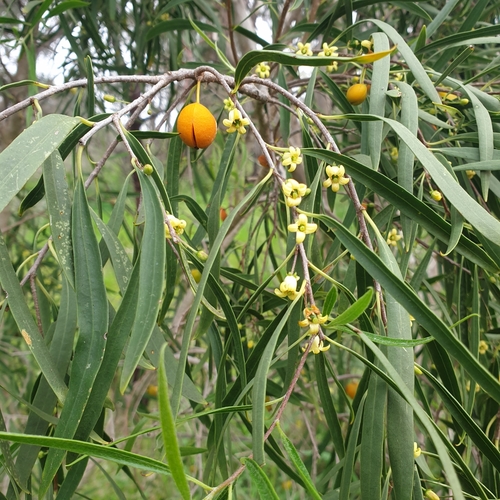
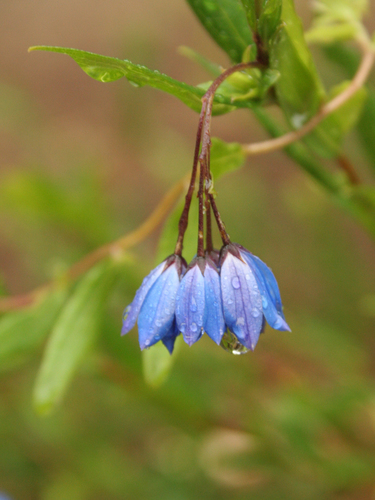
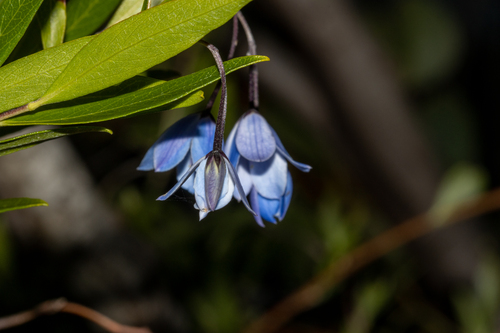
Billardiera fusiformis Labill. is a sturdy, shrubby climber. New stems are greenish and shaggy hairy, becoming reddish-brown as they mature. Adult leaves are linear to narrowly elliptic, 25–50 mm (0.98–1.97 in) long and 2–6 mm (0.079–0.236 in) wide, with no stalk (sessile). Both leaf surfaces are covered in soft hair when young, becoming hairless (glabrous) with age. Flowers grow singly or in groups of up to four on a 10–15 mm (0.39–0.59 in) long central rachis, and each individual flower sits on a nodding pedicel 6–10 mm (0.24–0.39 in) long. The sepals are covered in silky hair, 2–3 mm (0.079–0.118 in) long, and fall off as the flower matures. Petals are blue, white, or pink, 5–11 mm (0.20–0.43 in) long and about 3 mm (0.12 in) wide, and are free from one another. Flowering occurs in late spring and summer. The mature fruit is a green, spindle-shaped berry 20–25 mm (0.79–0.98 in) long that turns purplish as it ages. This species can be distinguished from other members of the genus Billardiera by its narrowly elliptic, nearly sessile leaves, deep blue, white or pink petals that are free from each other, and anthers that are nearly twice as long as their filaments; the anthers are fused to each other initially, and become free later. Commonly called Australian bluebell, this species was originally endemic to the south-west of Western Australia, where it grew in coastal and mallee heath in the Avon Wheatbelt, Coolgardie, Esperance Plains, Jarrah Forest, Mallee, Swan Coastal Plain and Warren bioregions. Horticultural use of the species in other Australian states, especially of its white and pink forms, has allowed it to become naturalized in those areas. It does not appear to be as invasive (weedy) as the closely related species B. heterophylla.