About Banksia squarrosa (R.Br.) A.R.Mast & K.R.Thiele
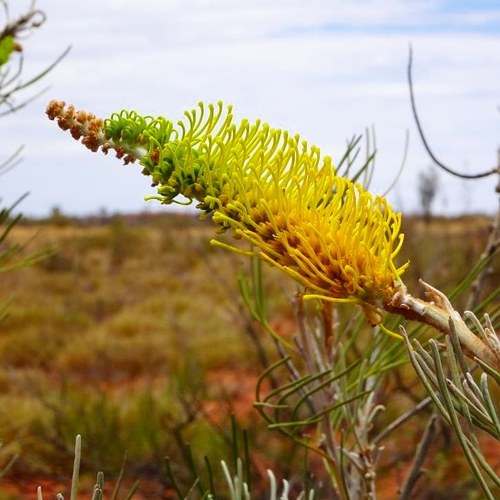
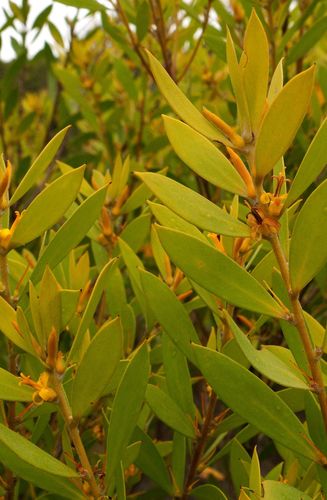
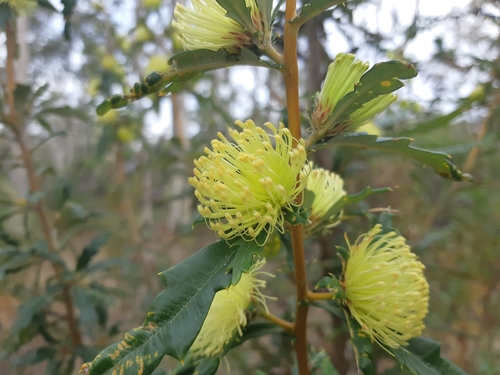
Banksia squarrosa is a shrub that usually grows up to 4 meters (13 feet) tall, and it does not form a lignotuber. It bears sessile leaves that are linear to narrow lance-shaped, measuring 30 to 90 millimeters (1.2 to 3.5 inches) long and 5 to 12 millimeters (0.20 to 0.47 inches) wide. Each side of the leaves has up to ten sharply pointed, triangular teeth. The species produces yellow flowers arranged in heads containing between fifty and seventy individual flowers. Narrow triangular to linear involucral bracts, 10 to 13 millimeters (0.39 to 0.51 inches) long, grow at the base of each flower head. The perianth is 18 to 24 millimeters (0.71 to 0.94 inches) long, while the straight pistil measures 20 to 26 millimeters (0.79 to 1.02 inches) long. Flowering takes place from June to November. After flowering, the plant forms oblong to egg-shaped follicles that are 8 to 13 millimeters (0.31 to 0.51 inches) long and more or less glabrous. Up to seven follicles develop in each flower head. This species, commonly known as Pingle, is widely distributed in the south-west of Western Australia, found between Bindoon, the Whicher Range and Albany, where it grows in woodland and forest. Subspecies argillacea has a restricted distribution near the western side of the Whicher Range. Subspecies squarrosa occurs across the entire species range, except in the area near the Whicher Range.