About Banksia spinulosa var. cunninghamii (Sieber ex Rchb.fil.) A.S.George
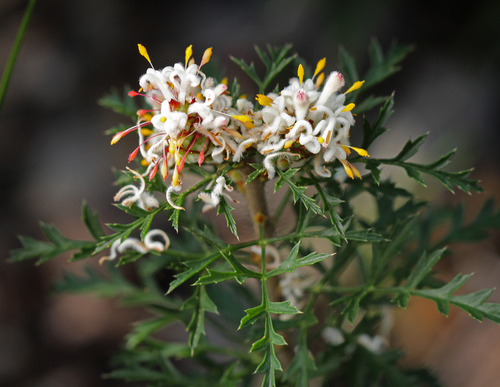
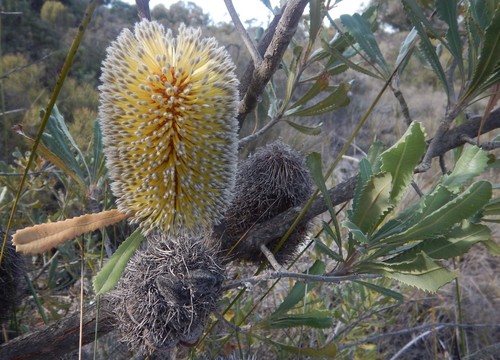
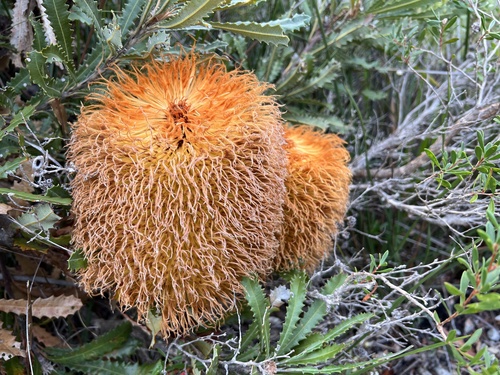
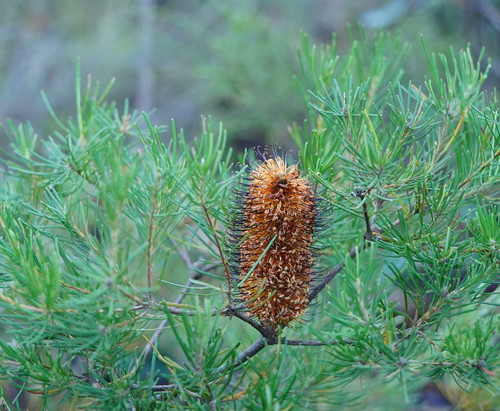
This is Banksia spinulosa var. cunninghamii, a variety of the hairpin banksia. Most hairpin banksias grow as multi-stemmed lignotuberous shrubs 1 to 3 metres tall and 1 to 2 metres across. Alternatively, they may grow as single-stemmed plants lacking a lignotuber, which are often taller, reaching up to 5 metres high. This variety matches the single-stemmed non-lignotuberous form. The plant has smooth grey or grey-brown bark marked with lenticels. Its leaves are long, narrow, and roughly linear in shape, measuring 3 to 10 cm long and 1 to 8 mm wide. Leaf margins may be entirely serrated, serrated only toward the tip, or recurved enough to hide serrations, such as on plants from Carnarvon Gorge. Broader, serrated immature leaves are often visible after bushfire. Unlike other varieties of hairpin banksia which have fine white hairs on leaf undersides, var. cunninghamii has pale brown hairs on the underside of its leaves. The species' distinctive cylindrical flower spikes emerge in autumn and early winter, measuring 6 to 7 cm wide and 6 to 15 cm tall. Each spike holds hundreds or thousands of individual flowers; each flower has a tubular perianth of four united tepals and a long, wiry hooked style. In line with the section this species belongs to, the styles are hooked rather than straight. Style ends are initially trapped inside the upper perianth parts, but break free when the flower opens. The flower spikes of Banksia spinulosa are yellow to golden orange, with styles that range in colour from yellow to pink, maroon, or black. Some populations have mixed style colours within short distances, while others are uniformly black, red, or gold. Though not growing at stem tips, the flower spikes are prominently displayed: they partially emerge from foliage and grow from two- to three-year-old stem nodes. After flowering, hairpin banksias form a characteristic cone-like Banksia infructescence, which holds up to 100 tightly packed embedded follicles 1 to 2.4 cm in diameter. These follicles generally stay closed until opened by bushfire. As a non-lignotuberous variety, var. cunninghamii is killed by bushfire and regenerates from stored seed, while varieties with lignotubers regrow from buds around the lignotuber base. Old flower spikes fade to brown then grey as they age. Old flower parts usually persist for a long time, giving the infructescence a hairy texture. This pattern does not hold for old cones of var. spinulosa and var. collina in Central and North Queensland, which are generally bare. The hairpin banksia is distributed along Australia's east coast, ranging from the Dandenong Ranges east of Melbourne, Victoria, north through New South Wales into Queensland. It is common as far north as Maryborough, with isolated disjunct populations reaching as far north as the Atherton Tableland near Cairns. It grows in a range of habitats including coastal heath, elevated rocky slopes, and inland dry sclerophyll eucalypt-dominated forest where it grows as part of the understorey. Plants growing in exposed sites are typically much shorter than those in sheltered sites. It most often grows on sand, but can also grow in rocky clays or loams. Banksia spinulosa var. cunninghamii occurs in three separate disjunct regions: the Dandenong Ranges east of Melbourne, East Gippsland between Lakes Entrance and Eden, and a band along the Great Dividing Range from Jervis Bay to Glen Davis in central New South Wales. Additional collections have been recorded further north along the Dividing Range into southeast Queensland. It can grow as an understorey plant under both dense and open forest cover. Like other banksias, Banksia spinulosa hosts a wide range of pollinators and is an important source of nectar in autumn, when few other plants flower. It has been the focus of many pollination studies. A 1998 study conducted in Bungawalbin National Park in Northern New South Wales found that small mammals including the marsupial yellow-footed antechinus (Antechinus flavipes) forage on the inflorescences of B. spinulosa var. collina, carrying pollen loads comparable to nectar-eating birds, making them effective pollinators. The same study also found that, unlike other studied banksias, B. spinulosa var. collina is visited primarily by native bees rather than the introduced European honeybee (Apis mellifera). Many species of birds have been observed visiting this species. A 1982 study in New England National Park in northeastern New South Wales found that a large influx of eastern spinebills (Acanthorhynchus tenuirostris) coincided with the start of local B. spinulosa flowering. On the Blackdown Tableland, white-eared honeyeaters (Lichenostomus leucotis), yellow-tufted honeyeaters (Lichenostomus melanops), and pygmy possums visit B. spinulosa. Brown antechinus, sugar gliders, and bush rats are also known to visit the flowers. Additional species recorded visiting flowers in the Banksia Atlas survey include white-cheeked honeyeater (Phylidonyris nigra), crescent honeyeater (Phylidonyris pyrrhoptera), Lewin's honeyeater (Meliphaga lewinii), brown honeyeater (Lichmera indistincta), noisy miner (Manorina melanocephala), noisy friarbird (Philemon corniculatus), red wattlebird (Anthochaera carunculata), and eastern yellow robin (Eopsaltria australis). Like most other Proteaceae, B. spinulosa develops proteoid roots: dense clusters of short lateral rootlets that form a mat in the soil just below the leaf litter. These roots improve nutrient solubilisation, allowing the plant to take up nutrients in the low-nutrient, phosphorus-deficient soils common to native Australian landscapes. Banksia spinulosa is not considered threatened. It is resistant to Phytophthora cinnamomi dieback, a major threat to many other Banksia species, and its broad distribution protects it from habitat loss from land clearing. As a result, it is not listed as threatened on Australia's threatened flora register under the Environment Protection and Biodiversity Conservation Act 1999. In New South Wales, it is listed in Part 1 Group 1 of Schedule 13 of the National Parks and Wildlife Act 1974; this classification means that as a common and secure species, it is exempt from any licensing or tagging requirements under the 2002–2005 management plan that regulates and minimises use of protected and threatened plants in the cut-flower industry. Var. spinulosa of Banksia spinulosa was introduced into cultivation in the United Kingdom in 1788 by Joseph Banks, who supplied seed to institutions including Kew, Cambridge Botanic Gardens, and Woburn Abbey. Var. collina followed in 1800, and var. cunninghamii was introduced in 1822. The species has proven to be a highly ornamental plant that attracts birds in cultivation. Provenances from southern and montane areas are frost hardy. All forms generally prefer sandy, well-drained soils in full sun, though some local forms originating from Wianamatta shales can tolerate heavier soils. It is resistant to dieback, like most eastern banksias. Because it naturally grows on acid soils, Banksia spinulosa is particularly sensitive to iron deficiency, a condition called chlorosis that causes new leaves to yellow while veins stay green. Chlorosis occurs when the plant is grown in higher pH soils, which can happen where soil contains cement from landfill or building foundations. It can be treated with iron chelate or iron sulfate. Regular pruning is recommended to maintain an attractive growth habit and prevent the plant from becoming leggy. Most cultivated forms have a lignotuber with dormant buds under the bark that respond to pruning or fire, so hard pruning down to near ground level is safe, as plants can easily resprout from old wood. This does not apply to var. cunninghamii, which should not be pruned below the foliage. Flowering can take up to eight years from germination; buying more mature plants or cutting-grown plants will speed up first flowering. Banksia spinulosa can be easily propagated from seed, and it is one of the easier Banksia species to propagate from cuttings. Named cultivars must be propagated from cuttings to retain the original plant's characteristics. Var. collina and var. spinulosa are both commonly sold in nurseries. Since the varieties can hybridise, it is environmentally preferable to source locally adapted plants from local community nurseries, Bushcare groups, or Australian Plants Society groups for planting in gardens near bushland with native populations. Several dwarf forms are available for urban gardeners: 'Stumpy Gold' is a var. collina form originally from the Central Coast of New South Wales, while 'Birthday Candles', 'Coastal Cushion', and 'Golden Cascade' are var. spinulosa forms from the South Coast of New South Wales.