About Banksia sphaerocarpa R.Br.
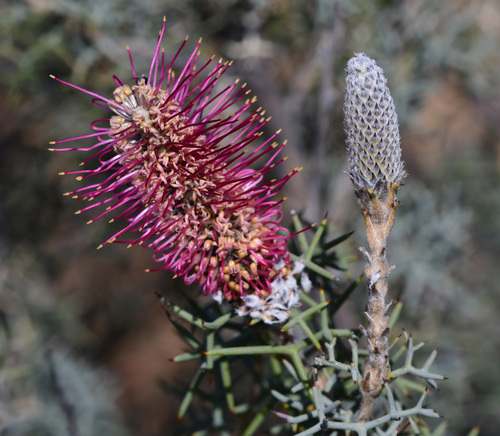
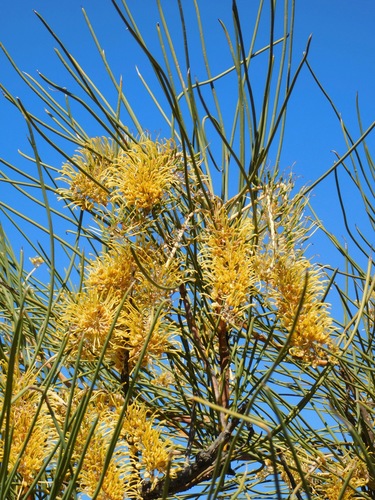
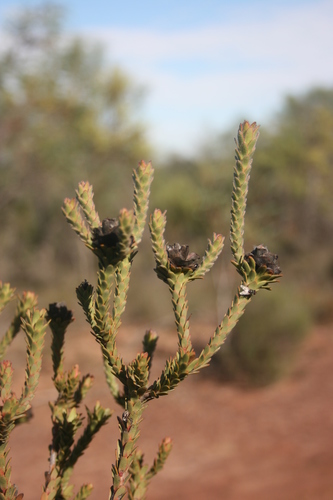
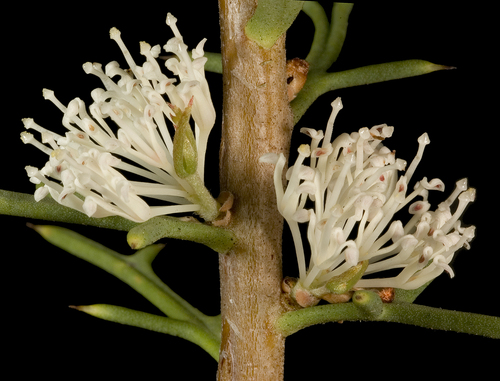
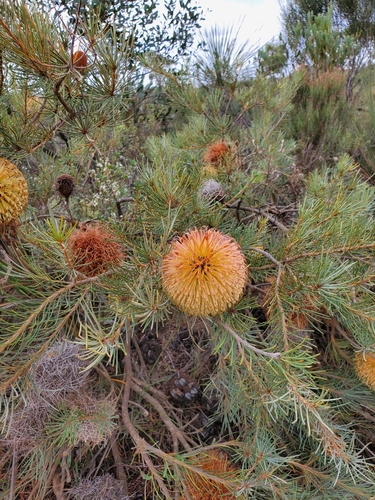
Banksia sphaerocarpa R.Br. is a highly variable species, with noticeable differences in plant size, flower size, and leaf size across its distribution. This marked variability has led to the recognition of five distinct varieties. The species typically grows as a shrub between 0.4 and 2 m (1.3 and 6.6 ft) tall. Plants are smaller in the northern part of the species' range, and grow larger in the southeast; var. dolichostyla and, rarely, var. caesia can reach up to 4 m (13 ft) in height. All varieties have a lignotuber, a swollen starchy root crown that allows the plant to resprout after bushfire. New stems are covered in fine hairs, and become smooth as they mature. Its leaves are stiff, narrow, and linear, measuring 2.5 to 10 cm (1.0 to 3.9 in) long, and grow on a 2–3 mm (0.08–0.12 in) petiole. Most varieties have leaves 1–1.5 mm (0.04–0.06 in) wide with a pointed tip, but var. latifolia has wider leaves, 2–2.5 mm (0.08–0.10 in), with a blunter tip. Foliage is usually green, but it has a paler blue-grey colour in var. caesia and var. dolichostyla. Inflorescences are generally globular, measuring 5 to 8 cm (2.0 to 3.1 in) in diameter, though larger forms such as var. dolichostyla have more oval shaped inflorescences. Flowering occurs from January to July, and blooms are yellow, orange, or brownish in colour. Development from bud to the end of flowering takes five to eight weeks. Anthesis occurs over two weeks, with individual flowers opening in a sequential wave across the inflorescence. Three weeks before flowers open, the spikes develop a strong musky scent. This species produces unusually large amounts of nectar, so much that nectar sometimes drips from the flowers to the ground. After flowering, old blooms fade to brownish and grey tones and remain curled around the flower spike. Up to 60 follicles can develop on globular spikes. Young follicles are finely furred, and become smooth and golden brown as they mature; mature follicles measure 1.5–3 cm (0.6–1.2 in) long, 0.5–0.8 cm (0.2–0.3 in) high, and 1–2.5 cm (0.4–1.0 in) wide. Follicles are flat with pronounced 'shoulders', giving them a rectangular appearance in cross section. Var. sphaerocarpa specimens from Whicher Range, Jarrah Forest, and the area around Nannup have larger follicles than other populations. Seeds are wedge-shaped (cuneate), measuring 2.0–2.6 cm (0.8–1.0 in) in total length, with a smaller cuneate seed body that measures 1–1.4 cm (0.4–0.6 in) long by 0.5–1.3 cm (0.2–0.5 in) wide. Small northern specimens can be hard to distinguish from Banksia micrantha, which has smaller inflorescences and large flattened follicles. Banksia sphaerocarpa is widely distributed across southwestern Western Australia, ranging from Eneabba in the north, south to Whicher Range, Nannup, Albany and Jerramungup, and east to the vicinity of Hyden. It grows mainly on sandy soils in flat or gently sloped areas within shrubland, mallee, or open woodland. A wide range of animals, including mammals, birds, and insects such as bees, wasps, ants, and beetles, have been observed visiting B. sphaerocarpa inflorescences, including the colletid bee Hylaeus sanguinipictus. In a 1980 published field study at Cheyne Beach, botanist Stephen Hopper found B. sphaerocarpa pollen on New Holland honeyeaters (Phylidonyris novaehollandiae) and honey possums (Tarsipes rostratus). Our understanding of this species' breeding system comes from a 2009 study of genetic structure within and across fragmented plant populations, which used B. sphaerocarpa var. caesia populations near Dongolocking (a landscape severely fragmented by land clearing) as a case study. Very little self-pollination was observed. Most mating occurred between plants in the same population, but inter-population mating accounted for 15–33% of seed, a very significant contribution to overall reproductive dynamics. This proportion was lowest in the smallest populations, which also had lower germination rates, smaller plants, and less genetic diversity than larger populations, which suggests interpopulation mating may confer a fitness advantage. The study also found evidence of fine-scale genetic structure, with plants tending to be more closely related to nearby plants than more distant ones, leading authors to suggest gene flow was probably already limited in these populations even before landscape fragmentation. B. sphaerocarpa is one of five closely related Banksia species that produce highly unusual flower nectar. While most Banksia species have clear, watery nectar, the nectar of these five species is pale yellow when first secreted, then gradually darkens and thickens, turning into a thick, olive-green mucilage within one to two days, and eventually becoming an almost black, gelatinous lump that adheres to the base of the flowers. This discoloration was first noted by Byron Lamont in 1980, who attributed it to cyanobacteria feeding on nectar sugars. Noting many of these cyanobacteria had heterocysts, Lamont speculated they aided the plant by fixing atmospheric nitrogen, which would be washed off flower heads by rain and absorbed by the plant's proteoid root mat. Barrett and Lamont investigated this proposed symbiosis in 1985, but found no evidence of nitrogen fixation. Further research by Markey and Lamont in 1996 indicated the discoloration is not caused by cyanobacteria or other microorganisms in the nectar, but is instead a chemical phenomenon originating from the plant. Their analyses found the nectar had unusually high levels of sugar and free amino acids, though three of the five species including B. sphaerocarpa have since been found to have normal nectar sugar compositions. Like most Western Australian Banksia species, B. sphaerocarpa is susceptible to dieback caused by the soil-borne water mould Phytophthora cinnamomi. In one experiment, 43% of plants died within three months of inoculation, leading the species to be rated moderately susceptible. In another experiment, 37% of plants died within three months, and 85% died within a year, but this study rated the species' susceptibility as high. In the second study, the death rate reached its maximum after 35 to 40 days, and remained at that level throughout the rest of the year, dipping only slightly during the dry summer months. No varieties of B. sphaerocarpa are commonly cultivated. They are difficult to grow in the wetter climate of Australia's east coast. Grafting trials have been very limited, and results have been poor. In drier regions with Mediterranean climates (winter moisture), they adapt well to gardens with good drainage, sandy soils, and sunny positions, and are also frost tolerant. They attract birds well, and flower at a time of year when few other plants are in bloom. Seeds require no pre-treatment before sowing, and germinate in 20 to 48 days.