About Banksia saxicola A.S.George
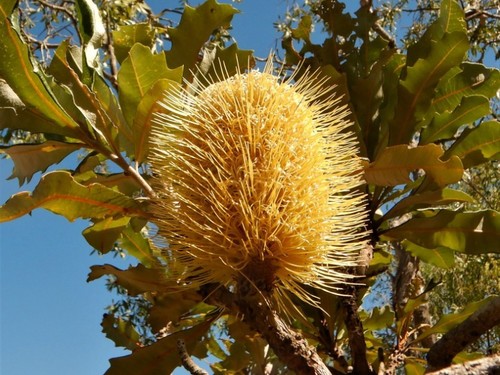
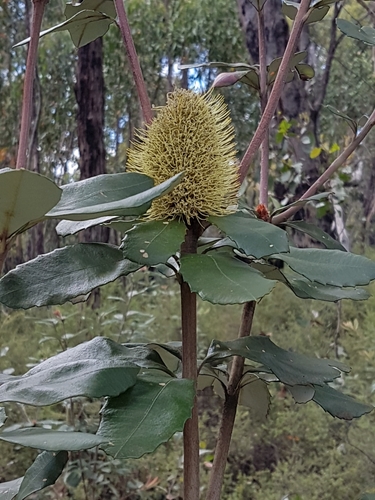
Banksia saxicola A.S.George has two distinct growth forms: it grows as a tall upright tree reaching up to 13 m (43 ft) high at Wilsons Promontory, and as a sprawling shrub in the Grampians. In the Grampians, plants keep their spreading growing habit even in more sheltered areas, reaching around 5 m (20 ft) high there, and reaching only 2 m (7 ft) high in more exposed sites. New growth emerges in summer. Its bark is 2–4 mm (0.08–0.2 in) thick; it is brown on younger plants, and grey and often covered in lichen on older plants. The leathery dark green leaves are roughly oval in shape, measuring 4 to 10 cm (1.6 to 3.9 in) long by 1 to 3.5 cm (0.4 to 1.4 in) wide. Leaves are arranged in whorls along stems, attached by 5–10 mm (0.2–0.4 in) long petioles. Flowering occurs from January to March, with occasional late flowers appearing in May. Cylindrical flower spikes, called inflorescences, grow from two- to six-year-old branches. At anthesis, these inflorescences are 3.5 to 8 cm (1.4 to 3.1 in) high and 5 to 6 cm (2.0 to 2.4 in) wide. As flower spikes age, flower parts detach to leave bare spikes, which then swell and develop 20 to 60 fine-furred follicles that only open after being burnt by fire. In the Grampians, Banksia saxicola grows on exposed summits, slopes, and gullies in scrub or woodland on loamy soil, most often growing among sandstone boulders alongside species such as brown stringybark (Eucalyptus baxteri). It has been recorded at Mt William, Major Mitchell Plateau, Mt Lubra, Mt Rosea, Mt Difficult, Stony Peak, Mt Thackeray and Chimney Pots Gap. Its northernmost populations grow on the margins of the Mt Difficult Plateau, 9 km southeast of Wartook, at altitudes above 600 m (2,000 ft). At Wilsons Promontory, it grows in taller forest at altitudes of 200 to 300 m (700 to 1,000 ft). When bushfire occurs, entire Banksia saxicola plants are killed, and the species regenerates from seed. Plants begin flowering four to five years after germination. The flower spikes of Banksia saxicola are an important nectar source for mammals, insects, and birds, especially honeyeaters. Bird species observed visiting the flower spikes of B. saxicola are the New Holland honeyeater and the crescent honeyeater. Banksia saxicola adapts easily to cultivation, particularly in cooler climates, and has been grown outdoors in the United Kingdom, Tasmania, and at Lees in the Netherlands. Its horticultural attractions are its attractive foliage and its furry follicles, which can have the appearance of being dusted with snow. Plants grown from seed flower within 3 to 4 years.