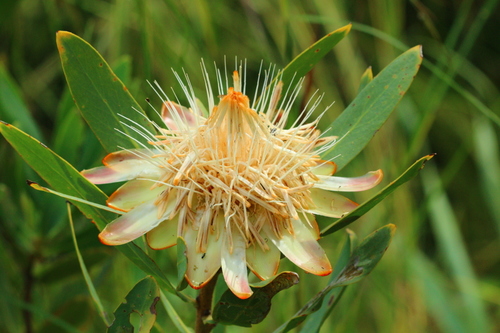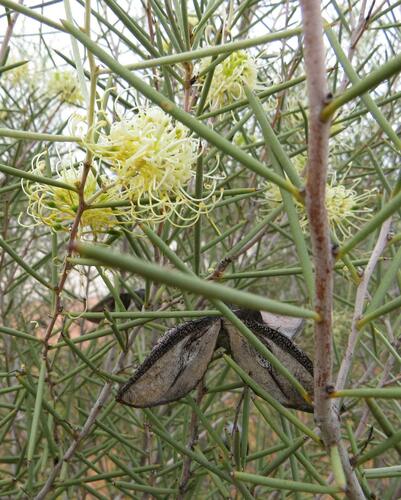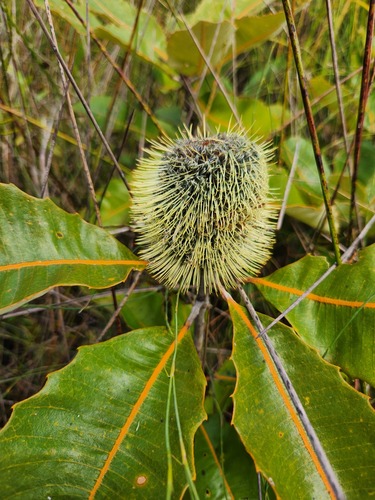
About Banksia robur Cav.
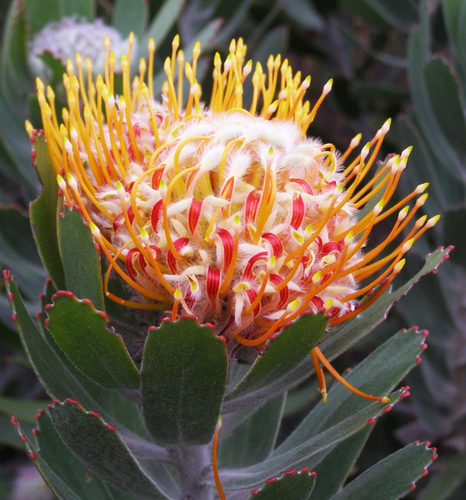
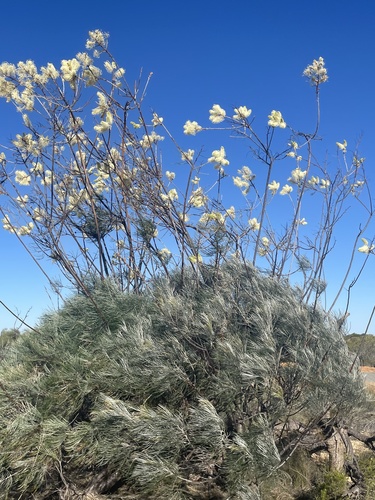
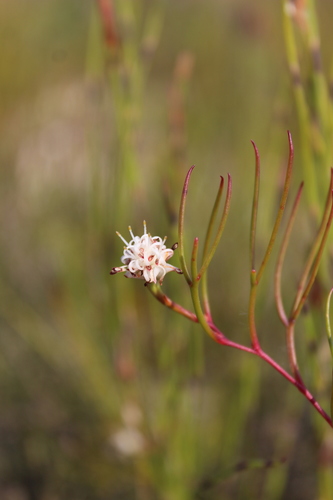
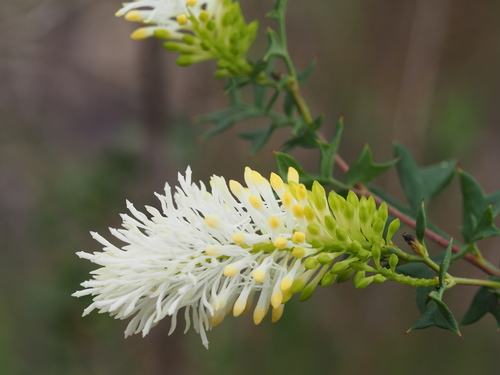
Banksia robur Cav. is generally a spreading shrub that grows up to 3 m (10 ft) tall. Larger single-stemmed specimens reaching 5 m (16 ft) in height have been recorded in Wooroi State Forest near Caloundra. Its grey-brown stems are 1–3 cm (0.39–1.18 in) thick and covered in smooth bark. New branchlets are densely covered in rust-coloured fur that remains for 1–2 years, and the upper tips of new growth bear furry prophylls. Leaves are arranged alternately along stems, measure 12–30 cm (4.7–11.8 in) long and 5–7 cm (2.0–2.8 in) wide, and have an oblong, obovate (egg-shaped), or elliptic shape. Populations from different regions flower at different times; some bloom in spring and summer, while others bloom predominantly in autumn. This species produces large flower spikes up to 15 centimetres (5.9 in) high and 5 to 6 centimetres (2.0 to 2.4 in) wide. When in bud, the flower spikes are metallic green with pinkish styles; they become cream-yellow as they open, then fade to golden-brown at the golden flowering stage. Old flowers turn grey and remain attached to old cones, hiding the plant's small follicles. When new, these follicles are reddish and covered in fur, before fading over time. Banksia robur is lignotuberous, meaning it can regenerate from the ground after fire. Banksia robur is native to coastal eastern Australia, where it occurs from New South Wales to north Queensland. The Banksia Atlas recorded it growing along two separate stretches of coastline: from Wollongong to South West Rocks in New South Wales, and from Brunswick Heads in northern New South Wales to Shoalwater Bay in Queensland, with a 200 km gap around Rockhampton between these stretches. Isolated populations are also found near Bowen, Julatten and Cooktown in north Queensland. It grows in low-lying sandy or peaty soils that are often seasonally damp or periodically inundated. In the Sydney basin, it grows alongside heath species including pink swamp-heath (Sprengelia incarnata), coral fern (Gleichenia dicarpa), and Leptocarpus tenax. Individual Banksia robur plants can live for more than 60 years. After bushfire, they resprout from buds located on their large woody lignotuber. Like other banksias, B. robur hosts a wide range of pollinators, including insects such as butterflies, moths, bees, wasps, ants and jewel beetles, as well as many bird species. Recorded bird pollinators include multiple honeyeater species: New Holland honeyeater (Phylidonyris novaehollandiae), little wattlebird (Anthochaera chrysoptera), brown honeyeater (Lichmera indistincta), tawny-crowned honeyeater (Gliciphila melanops), Lewin's honeyeater (Meliphaga lewinii), and little friarbird (Philemon citreogularis), all documented in the 1988 The Banksia Atlas survey. Since Banksia robur naturally grows in wet areas on sandy soils, these conditions are ideal for its cultivation. It grows best in a sunny position and benefits from additional water, particularly during active growth and dry periods. Propagation from seed is reliable. Rooting success has been achieved with hardened, pencil-thickness stem cuttings.