About Banksia quercifolia R.Br.
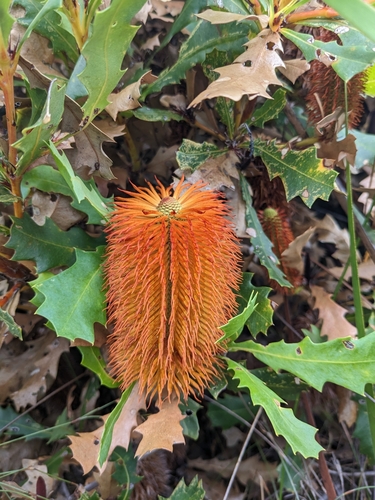
Banksia quercifolia R.Br. is a shrub that usually grows between 0.5 and 3 meters (1 foot 8 inches to 9 feet 10 inches) tall. It does not form a lignotuber. Young bark is smooth and greenish brown, and it becomes lightly tessellated and grey as the plant ages. Its leaves are wavy, serrated, and narrow wedge-shaped. They are 30–150 mm (1.2–5.9 in) long and 10–40 mm (0.39–1.57 in) wide, attached to a 1–4 mm (0.039–0.157 in) long petiole.
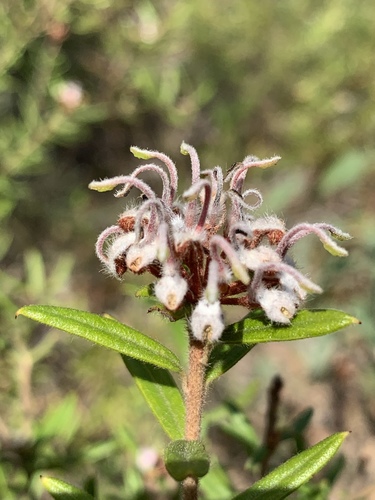
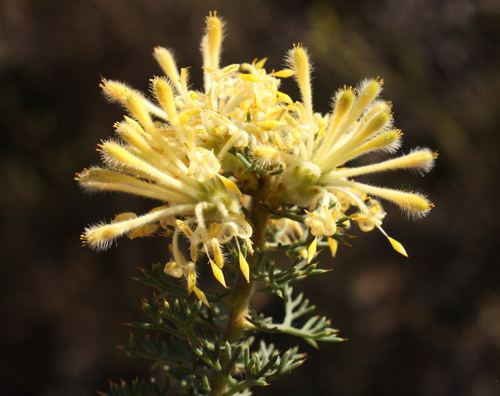
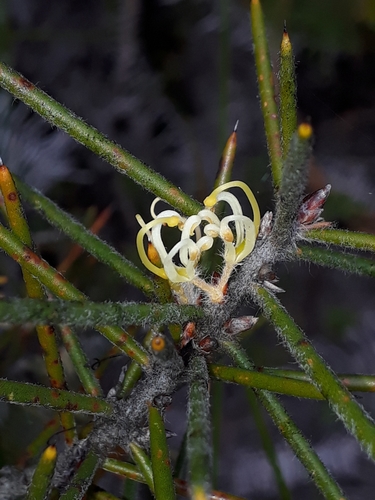
Flowers are arranged in a cylindrical spike, which measures 20–100 mm (0.79–3.94 in) long and 35–45 mm (1.4–1.8 in) wide when the flowers open. Individual flowers are yellow, orange, or brown, with a 23–27 mm (0.91–1.06 in) long perianth and a stiff, gently curved pistil that is 17–21 mm (0.67–0.83 in) long. Flowering takes place from March to November. After flowering, up to thirty-five follicles develop in each flower head, remaining surrounded by the remains of the old flowers. The follicles are broadly linear and wavy, measuring 15–20 mm (0.59–0.79 in) long, 11–15 mm (0.43–0.59 in) high, and 4–6 mm (0.16–0.24 in) wide.
Also called oak-leaved banksia, this species occurs along the south coast of Western Australia, ranging from D'Entrecasteaux National Park in the west to Mount Manypeaks in the east. It commonly grows in depressions, seasonally wet flats, and along swamp margins, in white or grey peaty sandy soils. A study assessing the potential impact of climate change on this species found its range is likely to contract by 50% to 80% by 2080, depending on the severity of climate change.
In horticulture, Banksia quercifolia is a fast-growing, bushy shrub that begins flowering within five years when grown from seed. Its flowers are sometimes hidden, but they are numerous and persist for many years. Due to its natural growing conditions, it can tolerate more moisture than other banksia species. Its seeds do not require any treatment before sowing, and germinate in 25 to 40 days.