About Banksia ornata F.Muell. ex Meisn.
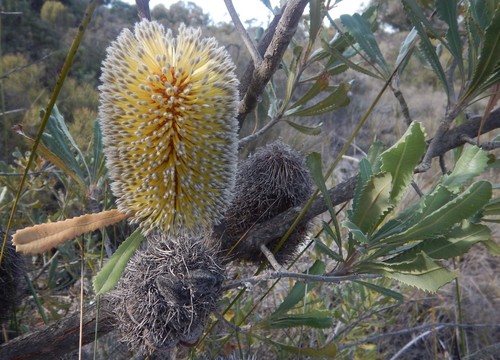
Banksia ornata F.Muell. ex Meisn. is a shrub commonly known as desert banksia, that typically grows to about 3 metres (9.8 feet) in height, and does not form a lignotuber. It has thin grey bark, and stems that are hairy when young, becoming hairless as they mature. Its leaves are narrow egg-shaped, with the narrower end at the base, or wedge-shaped. They are 30–100 mm (1.2–3.9 in) long and 4–25 mm (0.16–0.98 in) wide, growing on a 5–10 mm (0.20–0.39 in) long petiole. The species produces cream-coloured flowers arranged in a broadly cylindrical spike that is 50–110 mm (2.0–4.3 in) long and 70–80 mm (2.8–3.1 in) wide when flowers open. Hairy involucral bracts are present at the base of the spike, but these fall off before the flowers open. The perianth is 30–35 mm (1.2–1.4 in) long, and the pistil is 35–38 mm (1.4–1.5 in) long and slightly curved. Flowering can occur in most months of the year, but mainly takes place in winter and spring. Each spike can hold up to fifty elliptic follicles, which are 15–20 mm (0.59–0.79 in) long and 10–15 mm (0.39–0.59 in) wide, and are surrounded by the remains of older flowers. This species is common in western Victoria and South Australia. In South Australia, it occurs in the south-east of the state, south of Nuriootpa, including the lower Eyre Peninsula, Kangaroo Island, and areas east of Adelaide. In Victoria, it is restricted to the far west of the state, occurring mainly between Murrayville and the Grampians. It typically grows in mallee and heathland environments, in sandy, well-drained soils. Nectar-feeding birds are attracted to this shrub, and observed species that feed at its flowers include the red wattlebird (Anthochaera carunculata), brown-headed honeyeater (Melithreptus brevirostris), white-naped honeyeater (Melithreptus lunatus) and silvereye (Zosterops lateralis).