About Banksia media R.Br.
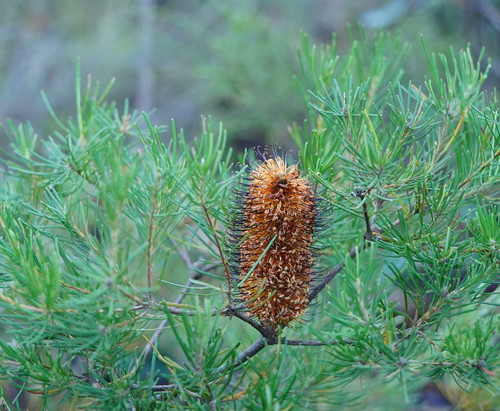
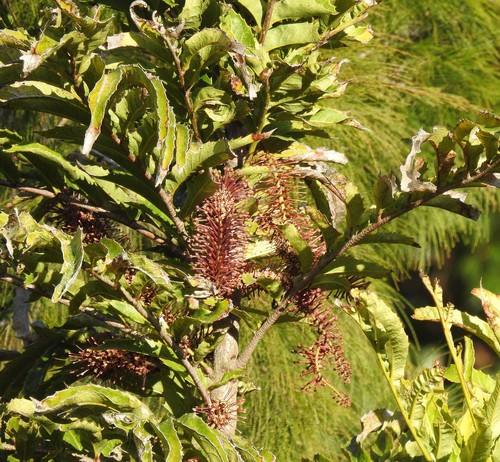
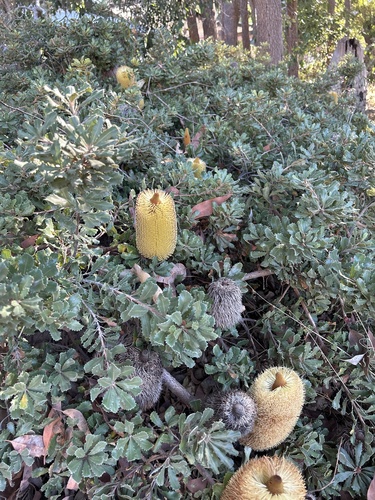
Banksia media R.Br. most often grows as a multi-stemmed shrub that reaches around 4 m (13 ft) in height, though specimens as tall as 10 m (30 ft) and 6 m (20 ft) wide have been recorded. Its trunk can grow up to 30 cm (12 in) in diameter. Some coastal populations, such as those at Point Ann, consist of prostrate plants whose flower spikes grow tall above the foliage. Unlike many other banksia species, B. media does not have a lignotuber. It has grey, fissured bark and hairy stems, and produces new growth during summer. Its dark green, wedge-shaped leaves are arranged alternately along stems, measuring 4 to 12 cm (1.8–4.2 in) long and 0.7 to 2 cm (0.3–0.8 in) wide, with serrated margins. Leaf size and shape varies across populations: plants from western and coastal parts of the species' range have shorter, broader leaves that measure 4 to 6 cm by 1 to 2 cm, while inland plants growing around Mt Charles and Mt Ragged have longer, narrower leaves with less revolute margins. Flowering occurs mainly between March and August, though occasional flower spikes may appear as late as December. The cylindrical flower spikes grow from the ends of short lateral branchlets on stems that are three to five years old, and generally measure 6 to 16 cm high and 7 to 8 cm (~3 in) wide when flowers open (at anthesis). In one population at Mt Ridley, flower spikes often reach 26 cm high. Each flower spike is a compound flowering structure called an inflorescence, where many individual flowers grow from a central woody axis. Banksia media is widely distributed across southern Western Australia, ranging from the eastern border of Stirling Range National Park across to Israelite Bay, and extending north to Pingrup, Frank Hann National Park, a location 15 km east northeast of Dowak, and a location 35 km northwest of Mt Buraminya. A separate disjunct population is found further east along the coast at Point Culver and Toolinna. The species is often locally abundant, and grows in a variety of soil types. It is most commonly found in white sand or sandy loam, but also grows in red clay, loam overlying limestone, shale, or granitic soil. Its typical habitats include heathland, shrubland, or open woodland. Banksia media is killed by bushfire and regenerates from seed. In Fitzgerald River National Park, where bushfires typically occur every 30 to 60 years, individual plants take around ten years after germination to grow, flower, and produce seed. The prominent colourful flower spikes attract vertebrate pollinators, and the species is visited by a range of animals including the honey possum and multiple honeyeater species: the New Holland honeyeater, white-cheeked honeyeater, red wattlebird, and western spinebill. Insect visitors include the meat ant and European honeybee. A field study that excluded pollinators found that B. media flower spikes can produce fruit without pollinator activity, meaning the species has some degree of self-compatibility. In cultivation, Banksia media shows relatively low susceptibility to dieback caused by the soil-borne water mould Phytophthora cinnamomi, which is unlike many other Western Australian banksia species. Its seeds do not require any treatment before sowing, and germinate within 20 to 46 days.