About Banksia lemanniana Meisn.
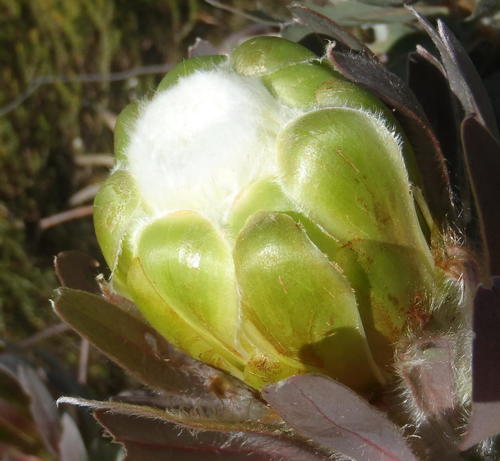
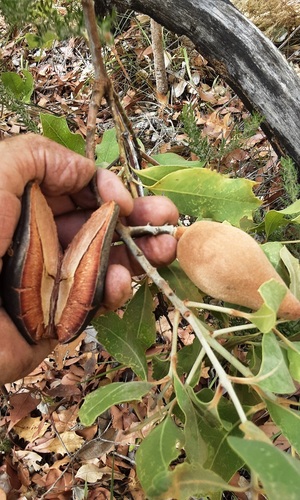
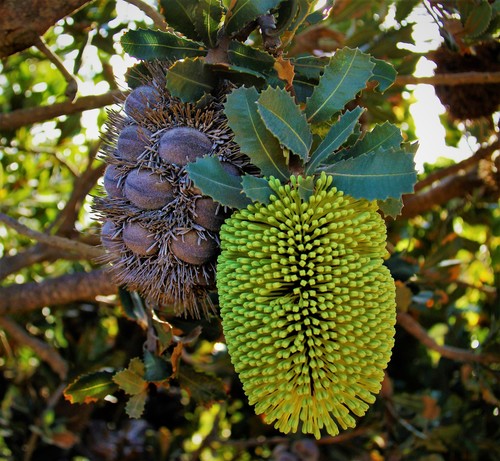
Banksia lemanniana Meisn. most often grows as an open spreading shrub, and less commonly grows as a small tree reaching up to 5 m (16 ft) in height. Its trunk has thin grey bark and can reach a diameter of 15 cm (5.9 in). Lower-growing plants reaching only 1.6 m (5.2 ft) have been recorded in the coastal areas of Fitzgerald River National Park. New growth is finely hairy, and develops mainly in summer; over two years, it loses its hairs and becomes glabrous, or smooth. Its stiff leaves are narrowly wedge-shaped to oval (cuneate to obovate), measuring 3–9 cm (1.2–3.5 in) long and 1.2–3 cm (0.47–1.18 in) wide. Leaf margins are serrated, with many teeth measuring 0.1 to 0.3 cm each. Flowering typically occurs between October and January. Unlike the inflorescences of most other banksias, the cylindrical inflorescences of B. lemanniana hang down from branchlets. They measure 5–11 cm (2–4 in) long and 8–10 cm (3.1–3.9 in) in diameter, are green-yellow in colour, have a honey scent, and drip large amounts of nectar. The buds are a deep chocolate brown until yellow flowers push through. As inflorescences age, they turn grey; old flowers remain as up to 20 large woody follicles develop. These follicles are oval in shape, have a wrinkled texture, are covered with fine hair, and can grow up to 4.5 cm (1.8 in) long, 3 cm (1.2 in) high, and 3 cm (1.2 in) wide. The obovate, fairly flattened seed measures 4–4.7 cm (1.6–1.9 in) long. It is made up of a wedge-shaped seed body proper (measuring 1.2–1.5 cm (0.5–0.6 in) long and 1–1.3 cm (0.4–0.5 in) wide) and a papery wing. One side, the outer surface, is dark brown and wrinkled, while the opposite side is black and smooth. Both sides have a slight sparkle. Seeds are separated by a sturdy dark brown seed separator with roughly the same shape as the seeds; it has a depression where the seed body sits adjacent to it inside the follicle. Seedlings have wedge-shaped (cuneate) cotyledons that measure 1.2–1.5 cm (0.5–0.6 in) long and 1.5–1.8 cm (0.6–0.7 in) wide. The cotyledons are dull green, sometimes with a reddish tinge, and the edge of the wedge may be crenulated, lined with small teeth. The hypocotyl is red, measuring 1–2 cm (0.39–0.79 in) high and 0.25–0.3 cm (0.098–0.118 in) wide. This species is found near the southern coast of Western Australia, with most of its population located within protected Fitzgerald River National Park. Outside the park, its range extends to the Ravensthorpe Range to the northeast, the rabbit-proof fence to the east, and as far west as Pallinup estuary with isolated populations. It grows in areas with an annual rainfall of 500–600 mm (20–24 in), on hill tops and slopes, as well as flatter areas, growing in rocky, lateritic, or sandy soil, in mallee scrubland or heath. Because most of its range is within a national park, and it is not collected for the cut flower industry, B. lemanniana is relatively secure. It is therefore classified as Not Threatened under Western Australia's Wildlife Conservation Act. A variety of pollinators have been recorded visiting its flower spikes, including the New Holland honeyeater (Phylidonyris novaehollandiae), red wattlebird (Anthochaera carunculata), native and European honey bees, wasps, and ants. Nectar drips from the flower spikes onto the ground and lower leaves, which suggests attraction of nonflying mammal pollinators to the scent; the downward-hanging inflorescences may help facilitate this pollination process. B. lemanniana is killed by bushfire and regenerates from seed. It is unclear how quickly seedlings reach flowering in the wild, but cultivated plants show flowering occurs around five to six years after germination. If bushfire occurs too frequently, plants are burned before reaching maturity or before they produce enough seed for population regeneration, which can lead to population decline or even local extinction. If there is too long an interval between fires, population decline also occurs: more plants die of natural attrition without releasing their seed, resulting in seed wastage. Unlike many Western Australian banksias, B. lemanniana has a low to moderate susceptibility to dieback caused by the soil-borne water mould Phytophthora cinnamomi. A study of cultivated plants in South Australia inoculated with P. cinnamomi and P. citricola found B. lemanniana has an overall low susceptibility to both organisms, though 2-to-3-week-old seedlings were more vulnerable than 10-month-old seedlings. One of the easier Western Australian Banksia species to grow, B. lemanniana has horticultural value for its attractive chocolate buds, green-yellow hanging flower spikes, and large grey old spikes with prominent follicles. It generally grows quite quickly, but still takes five to six years to flower when grown from seed. It prefers more alkaline rocky or sandy soil, with an ideal pH range from 6 to 7.5. It grows best in a sunny position with good drainage, and has been successfully cultivated in more humid climates on Australia's east coast. Seeds do not require any treatment before sowing, and take 27 to 43 days to germinate.