About Grevillea sphacelata R.Br.
Taxon Naming and Growth Form
Grevillea sphacelata R.Br. is a spreading to erect shrub that typically reaches 0.4–2.5 m (1 ft 4 in – 8 ft 2 in) in height, and has branchlets covered in silky hairs.
Leaf Shape and Dimensions
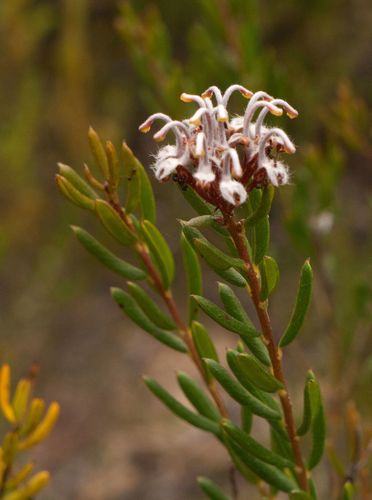
Its leaves are narrowly linear to oblong, between 7–35 mm (0.28–1.38 in) long and 2–4 mm (0.079–0.157 in) wide, with edges that are turned down or rolled under.
Leaf Surface Characteristics
The upper surface of the leaves is hairless, while the lower surface is covered in silky hairs.
Flower Arrangement
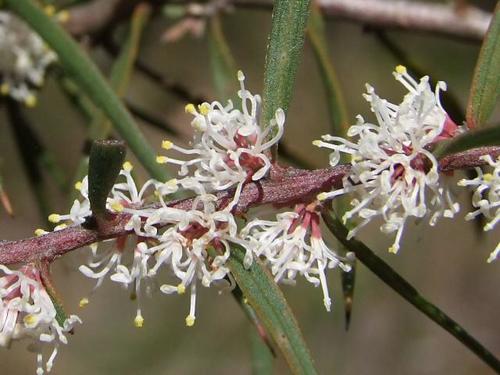
Flowers are arranged in umbel-like clusters, with flowers at the ends of clusters opening first.
Flower Color and Indumentum
Each flower is pale brown and pink, covered in greyish hairs.
Pistil and Style Morphology
The pistil measures 9–12 mm (0.35–0.47 in) long, and the style is pinkish-grey.
Flowering Period and Fruit Traits
Flowering occurs mainly from July to January, and the fruit is an oval follicle 18–20 mm (0.71–0.79 in) long.
Distinguishing Features from Congeners
This species can be distinguished from its close relative Grevillea phylicoides by the absence of spreading hairs on its branchlets and leaves, and by the absence of a prominent appendage at the end of the style.
Habitat
Grevillea sphacelata grows in woodland and heath habitats.
Primary Distribution Range
It occurs mainly on the Woronora Plateau, generally across the Sydney Basin, extending south to Dapto and west to Mittagong.
Disjunct Population Location
There is also a disjunct population between Nowra, Huskisson and Wandandian on the south coast of New South Wales.
Cultivation Status
This species is rarely found in cultivation as an ornamental plant, but it is currently cultivated by a small number of members of the Australian Plants Society Grevillea study group.
Cultivation Soil and Light Requirements
It is a hardy plant that can grow in a wide range of soils, but grows best in well-drained, sandy, acidic soil located in full sun or part shade.
Tolerance to Environmental Conditions
It is tolerant of extended dry periods, but is not tolerant of drought, and can withstand frosts as cold as -4°C (24.8 °F).