About Banksia ilicifolia R.Br.
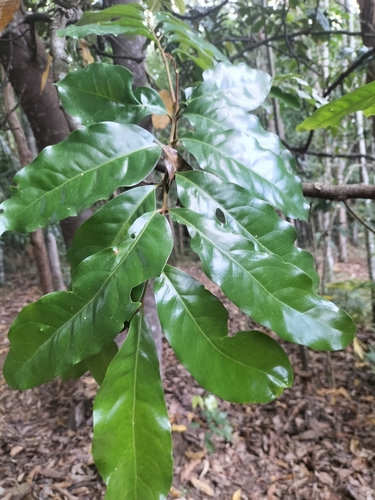
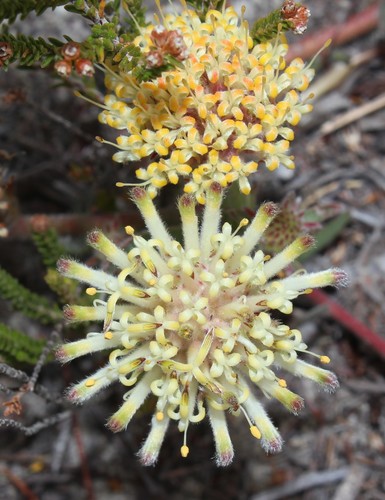
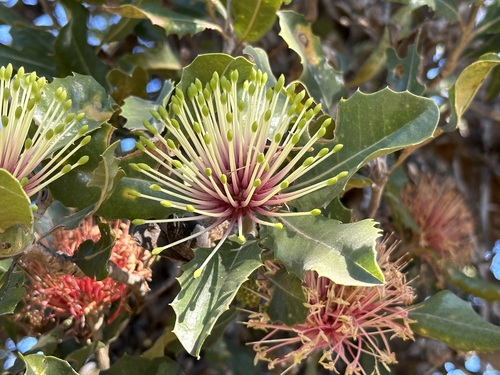
Banksia ilicifolia R.Br., commonly known as holly-leaved banksia, is a variable species. It usually grows as an erect tree up to 10 metres (33 ft) tall, though some south coast populations consist of small trees or even spreading shrubs. In the Margaret River region, it typically grows as a small tree reaching 5 metres (16 ft) in height. It forms dense foliage close to the trunk and branches from leaves growing on many short branchlets. It has a stout trunk up to 50 cm (19.5 in) in diameter, covered in rough, fibrous, grey bark up to 2 cm (1 in) thick. New growth occurs mainly in summer. Young branchlets are covered in hair that is lost after two or three years. Leaves grow on stems less than two years old, arranged in a scattered pattern along stems though crowded at branchlet tips. Resembling holly leaves, they are dark shiny green, vary in shape from obovate (egg-shaped) and elliptic to truncate or undulate (wavy), and measure 3–10 cm (1.2–3.9 in) long. Leaf edges are generally serrated, with up to 14 prickly "teeth" separated by broad V- to U-shaped sinuses along each side, though some leaves have entire margins. Leaves are borne on petioles 0.3–1 cm (0.1–0.4 in) long. Both upper and lower leaf surfaces are initially covered in fine hairs, becoming smooth as they mature. Flowering occurs from late winter to early summer. Unlike many other banksias that have spike-shaped inflorescences, B. ilicifolia produces dome-shaped flower heads that grow from stems around one year old. No lateral branchlets grow from the node where the flower head forms. Flower heads measure 7–9 cm (2.8–3.5 in) in diameter, and hold 60 to 100 individual flowers. Inflorescences go through three colour phases: starting yellow, turning pink, and finally red before falling from the head. One to three woody fruit structures called follicles develop from fertilized flowers, and remain embedded in the woody base of the flower head. Each follicle holds one or two seeds. The species' cotyledon (seed leaf) leaves are dull green with no visible veins or markings. They are transversely elliptic, measure 8 to 13 mm long by 12 to 18 mm wide, and range from convex to concave. Their pointed spreading auricles are 1.5 mm long. Cotyledons sit atop a stout, green, smooth hypocotyl. Seedling leaves grow crowded above the cotyledons. They resemble the seedling leaves of Banksia coccinea, are lined with triangular lobes or "teeth" separated by U- or V-shaped sinuses, and range in shape from obovate to broadly lanceolate. The first set of seedling leaves measures 1 to 2.5 cm (0.4 to 1.0 in) long and around 1 cm (0.4 in) wide, with three or four lobes per margin. Both upper and lower surfaces of seedling leaves, as well as the seedling stem, are covered in spreading hairs. Juvenile leaves are obovate to truncate or mucronate with triangular lobes, and measure 4 to 10 cm (1.6 to 3.9 in) long by 1.5 to 3.5 cm (0.6 to 1.4 in) wide. These lobes are smaller toward the petiole and leaf apex. In the Margaret River region, B. ilicifolia has been confused with Banksia sessilis var. cordata because both have prickly foliage and domed flower heads. However, B. ilicifolia grows on deep sand, while B. sessilis var. cordata grows on grey sand over limestone ridges. Another distinguishing feature is that B. ilicifolia's follicles are embedded in the flower head base, while those of B. sessilis are loose. A relatively common species, holly-leaved banksia is widely distributed across southwest Western Australia. It occurs within 70 km (43 mi) of the coast, from Mount Lesueur to Augusta, then east to the Cordinup River east of Albany. In the Margaret River region, it grows on yellow sand plains behind the Leeuwin-Naturaliste Ridge. Almost all populations occur on the west (seaward) side of the Darling Scarp, though there are two outlying populations: one near Collie east of Bunbury, and another in the Tonbridge-Lake Muir area near Manjimup. Along the south coast, there is one inland population at Sheepwash Nature Reserve near Narrikup, northwest of Albany. Annual rainfall across its distribution ranges from 600 to 1,100 mm (24 to 43 in). B. ilicifolia grows exclusively on sandy soils, and its range ends where heavy soils begin. It especially favors low-lying areas. It generally grows in open woodland alongside trees such as jarrah (Eucalyptus marginata), candlestick banksia (Banksia attenuata), firewood banksia (B. menziesii) and Western Australian Christmas tree (Nuytsia floribunda). Along the south coast, it grows in heath, sometimes forming stands with bull banksia (B. grandis). This species gives its name to Banksia ilicifolia woodlands (community type 22), a possibly threatened ecological community found in the Bassendean and Spearwood sand systems of the central Swan Coastal Plain north of Rockingham. These are low-lying seasonally waterlogged areas, forming open woodland with an open understorey, where B. ilicifolia, B. attenuata, and stout paperbark (Melaleuca preissiana) occur. B. ilicifolia is also a component of the critically endangered Assemblage of Tumulus Springs (organic mound springs) of the Swan Coastal Plain community north of Perth, which is defined by permanently moist peaty soil. Dominant trees of this community include Melaleuca preissiana, swamp banksia (B. littoralis) and flooded gum (Eucalyptus rudis), with understorey ferns such as bracken (Pteridium esculentum) and Cyclosorus interruptus, and shrubs swamp peppermint (Taxandria linearifolia) and Astartea fascicularis. Field studies in Scott National Park have recorded B. ilicifolia as a nectar source for the honey possum (Tarsipes rostratus) from winter to early summer (May to December), after which Adenanthos meisneri replaces it as a main nectar source. Several honeyeater species visit and pollinate B. ilicifolia; the western spinebill (Acanthorhynchus superciliosus) in particular prefers this species over other banksias. A 1988 field study at Jandakot Airport south of Perth found that birds and insects overwhelmingly preferred to visit yellow-coloured flower heads. Recorded visiting species included multiple honeyeaters: red wattlebird (Anthochaera carunculata), western wattlebird (A. lunulata), western spinebill, brown honeyeater (Lichmera indistincta), New Holland honeyeater (Phylidonyris novaehollandiae), white-cheeked honeyeater (P. nigra), singing honeyeater (Gavicalis virescens), as well as the twenty-eight parrot (Barnardius zonarius semitorquatus), two native bee species of the genus Leioproctus, a beetle of the genus Liparetrus, and the ant species Iridomyrmex conifer. Yellow flower heads also produce the most nectar, and are strongly preferred by red wattlebirds. An analysis of invertebrate populations in Banksia woodland canopies found that mites and ticks (Acari), beetles (Coleoptera) and ants, bees and wasps (Hymenoptera) were overall dominant, and these three orders were also common on B. ilicifolia, though outnumbered by thrips (Thysanoptera). Higher numbers of arthropods on B. ilicifolia may be linked to higher potassium levels in its leaves. Lower overall invertebrate numbers on Banksia species were thought to be related to the presence of insectivorous birds. Hand-pollination experiments on wild populations near Perth showed that B. ilicifolia is self-compatible, though selfed progeny have less vigour and seed production is reduced. Further experiments showed that seedlings from outcrossing between plants over 30 kilometres (19 mi) apart are more vigorous and adaptable, indicating that plants breeding within small fragmented populations face reduced vigour and genetic inbreeding. B. ilicifolia regenerates after bushfire by regrowing from epicormic shoots under its bark. Its follicles open and release seeds after several years; it is weakly serotinous, like eight other Banksia species, all of which tend to occur in southwestern corner of Western Australia. The other two species of the subgenus Isostylis are killed by fire and regenerate only from seed. Like all banksias, B. ilicifolia develops proteoid (cluster) roots adapted to nutrient-poor Australian soils, particularly those low in phosphorus. The plant produces masses of fine lateral roots that form a mat-like structure just below the soil surface, allowing it to extract nutrients as efficiently as possible. A study of three co-occurring species in southwestern Australian Banksia woodland — B. menziesii, B. attenuata and B. ilicifolia — found that all three produce fresh roots in September after winter rainfall, that the bacterial communities associated with the root systems of B. menziesii differ from those of the other two species, and that bacterial communities also change depending on root age. In addition to shallow lateral roots, B. ilicifolia grows one or more deep taproots that reach for the water table. It is an obligate phreatophyte, meaning it relies on accessing groundwater to survive. It is more tightly linked to the water table than co-occurring B. menziesii and B. attenuata, and only grows in areas where the water table is less than 8 m (26 ft) below the surface. Since the mid-1960s, falling water tables on the Swan Coastal Plain — caused by extraction from the Gnangara Mound aquifer for Perth's water supply combined with years of below-average rainfall — have led to considerable declines in B. ilicifolia population size and vigour, with this species affected more than other co-occurring banksia species. Like many Western Australian banksias, B. ilicifolia is highly sensitive to dieback caused by the soil-borne water mould Phytophthora cinnamomi. A 16-year study of Banksia attenuata woodland 400 km (250 mi) southeast of Perth, conducted after a wave of P. cinnamomi infestation, found that B. ilicifolia populations were still present but significantly reduced in diseased areas. Specimens growing in coastal dune vegetation have been reported killed by the fungus Armillaria luteobubalina, with fungal mycelial sheaths forming under the bark of the root collar. B. ilicifolia is rarely cultivated. It requires a sunny position and sandy, well-drained soil to grow well. It is a slow-growing plant, taking up to ten years to flower from seed. Its glossy green foliage, long flowering period, and prominently displayed flowers give it horticultural potential, though its prickly foliage makes fallen leaves a problem when planted near lawns or walkways. Seeds require no pretreatment, and germinate in 22 to 41 days. Difficulty collecting seeds and low seed set make seed relatively expensive, as seeds are often eaten by insects before they can be collected.