About Cardwellia sublimis F.Muell.
Size and Growth Habit
Cardwellia sublimis is a large tree that reaches up to 40 m (130 ft) in height and 2 m (6 ft 7 in) in diameter. It often grows as an emergent tree, standing well above the surrounding forest canopy.
Bark and Root Features
It has thin bark, and usually does not develop buttress roots.
General Leaf Characteristics
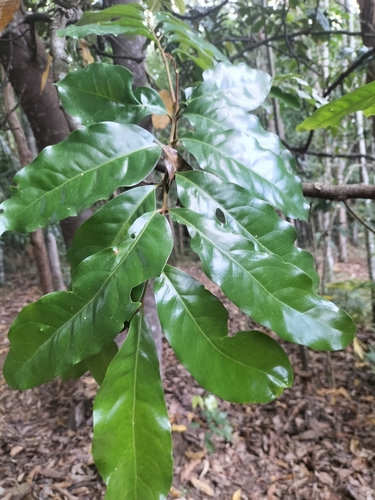
Its leaves are arranged alternately; they are dark green on the upper surface, and have a silvery brown sheen on the lower surface. Seedlings have simple leaves, while mature trees produce pinnately compound leaves. Leaf morphology changes gradually as the tree grows.
Mature Leaf Measurements
On mature trees, leaves can reach up to 65 cm (26 in) long, with a petiole up to 11 cm (4.3 in) long. Mature leaves have 3 to 10 pairs of oval to oblong leaflets, each measuring 9–18 cm (3.5–7.1 in) long and 4–7 cm (1.6–2.8 in) wide.
Inflorescence Structure
The inflorescence of this species is a raceme up to 16 cm (6.3 in) long, which carries pairs of sessile flowers on a short peduncle.
Flowering Traits
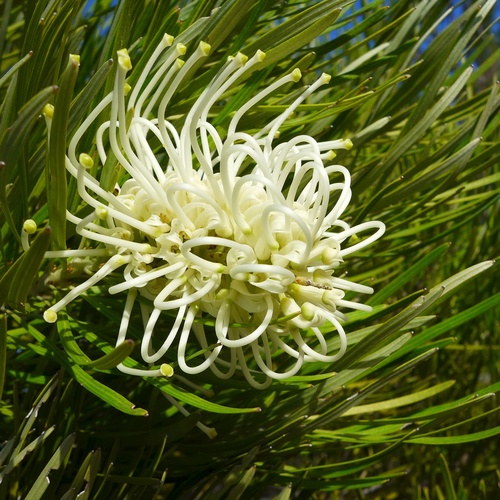
Flowers are produced above the tree canopy, and are produced in large numbers; in late spring and summer, the entire tree canopy can become covered with these cream-white flowerheads.
Fruit Characteristics
The fruit are large, ellipsoidal, woody, dehiscent follicles, measuring about 8–11 cm (3.1–4.3 in) long and 5–6 cm (2.0–2.4 in) wide. The fruits are held on vertical peduncles and displayed above the canopy, a distinctive feature of the species.
Fruit and Seed Details
They split along one side to release their seeds, and can persist for some time both on the tree and on the ground after falling. Each fruit contains up to 14 winged seeds, which measure about 7 by 3 cm (2.8 by 1.2 in).
Geographic Distribution
Cardwellia sublimis is endemic to a small area of northeastern Queensland, Australia, where it occurs from the area around Rossville south to Paluma Range National Park.
Habitat Requirements
It grows from coastal flats inland to the adjacent ranges and tablelands, in rainforest on a wide variety of soil types, at altitudes ranging from sea level to around 1,300 m (4,300 ft).
Faunal Interactions
In its native habitat, ants in the family Formicidae bite and wound the trunks of northern silky oak (the common name of C. sublimis) to access and consume the tree's sugary sap. The seeds of this species are eaten by sulphur-crested cockatoos (Cacatua galerita) and native rats.
Historical Timber Use
In the past, Cardwellia sublimis was harvested extensively for its well-regarded timber, which was widely used in traditional Queenslander-style houses, particularly for window construction. It was also commonly used for furniture, joinery, and flooring.
Modern Timber Status
Today the timber is in limited supply, and is now mostly used for cabinet work and veneers. Attempts to grow C. sublimis in commercial plantations have not been very successful.
Horticultural Potential
However, the species has good potential as a park and street tree, due to its large size, attractive foliage, and showy flowering displays. It can be readily propagated from seed, though seed must be fresh (stored for less than 6 weeks), and it has been grown successfully in Melbourne.