About Banksia dentata L.fil.
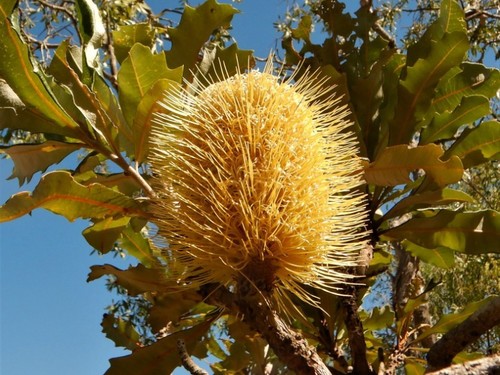
Banksia dentata L.fil., commonly called tropical banksia, is typically a small tree. It usually grows around 4 m (13 ft) tall, and may reach up to 7 m (23 ft) tall. It has a rough, stocky trunk, a spreading crown, and crooked branches. Its dark grey bark has a non-flaky, tessellated texture and appearance. Young branchlets are initially covered in reddish hair that wears away over time, and mature branchlets become smooth and grey. Its large green leaves are scattered along stems and more crowded at the tips of branchlets. Leaves measure 9–22 cm (3.5–8.7 in) long and 2–9 cm (0.8–3.5 in) wide, are obovate with mucronate tips, and have undulate surfaces with white undersides. Their dentate margins bear irregular 0.1–1.3 cm (0.04–0.5 in) long teeth separated by U-shaped sinuses. The leaf midrib is raised on the underside and depressed on the upper surface. Cylindrical yellow inflorescences grow from one- to three-year-old branches, appearing between November and May. The inflorescences measure 10 to 13 cm (3.9 to 5.1 in) high and 5 to 10 cm (2.0 to 3.9 in) wide. Newly opened flower spikes have a scent similar to corn. All flower structures are pale yellow; the perianth is 2.5–3.2 cm (1.0–1.3 in) long, including a 0.5 cm (0.2 in) long limb. After anthesis, the pistil measures 3.1–4.6 cm (1.2–1.8 in) long. As spikes age, flower parts quickly fall off, and the spikes develop into irregular-cylindrical infructescences. The oval follicles are 1.5–2 cm (0.6–0.8 in) long, 0.4–0.8 cm (0.16–0.31 in) high and 0.5–0.8 cm (0.2–0.3 in) wide. Young follicles are pale green and furry, and become smooth and pale brown as they mature. Follicles open spontaneously once fully mature, and each holds two seeds, with a woody dark brown separator of a similar shape to the seeds between them. Seeds are 1.8–2.1 cm (0.7–0.8 in) long, obovate, and made up of a dark brown membranous 'wing' 1.1–1.4 cm (0.4–0.6 in) wide, plus an obovate seed proper that measures 1.0–1.2 cm (0.4–0.5 in) long by 0.5–0.8 cm (0.2–0.3 in) wide. The seed surface may be smooth or covered in tiny ridges. Bright green cotyledons are obovate, measuring 1.6–1.9 cm (0.6–0.7 in) long by 0.8–1.1 cm (0.3–0.4 in) wide. Each cotyledon has two pointed auricles around 1.5 mm (0.06 in) long at its base. Cotyledons emerge from a smooth hypocotyl that is 3–4 mm (0.12–0.16 in) high and 1–1.5 mm (0.04–0.06 in) in diameter. The first seedling leaves grow in opposite arrangement, arising 3–4 mm above the cotyledons. Each early seedling leaf is roughly linear, measuring 2.5–2.7 cm (1.0–1.1 in) long and 0.4–0.5 cm (0.16–0.20 in) wide, with two to three serrations (teeth) on the upper quarter to third of the leaf margin. The leaf underside is covered in white hair. Later seedling leaves become more obovate, measuring 3–7 cm (1.2–2.8 in) long and 0.8–1.2 cm (0.3–0.5 in) wide, with dentate margins and mucronate tips. All seedling stems are hairy. This species ranges across northern Australia: it has been recorded from as far west as the Wunaamin Miliwundi Ranges in the western Kimberley, through the Northern Territory, south to Nitmiluk Gorge, and into Queensland, where it occurs on Cape York Peninsula as far south as Cooktown. It has also been recorded off the northern Australian coast on Groote Eylandt, the Wessel Islands, Melville Island, and Bathurst Island. It extends further to the Aru Islands, where it grows around Trangan, and into New Guinea. In New Guinea, its range in the south runs from Merauke east to Port Moresby, and it also occurs around Bulolo and Mount Mau. It is the only Banksia species that is not endemic to Australia. Since much of its range falls within remote, poorly surveyed land, it may grow more widely than current records indicate. Pollen evidence shows it has been present on the Torres Strait Islands for the past 8,000 years, though it has never been a prominent part of the islands' flora. Banksia dentata most often grows on sandy soils in savanna woodland or shrubland, along freshwater swamps, watercourses, floodplains, or other seasonally wet areas. It has also been found on quartzite or sandstone rocky outcrops. In Australia it grows up to around 500 m (1,600 ft) in elevation, and reaches up to 1,200 m (3,900 ft) in New Guinea. In New Guinea, it is restricted to regions with a distinct dry season. It is frequently found growing alongside Melaleuca and Pandanus species. On Cape York Peninsula, it is a dominant species in a low scrub community called "wet desert", named for its resemblance to arid scrub despite occurring in a monsoon climate. On phosphorus-poor soils, it grows with Melaleuca saligna and Thryptomene oligandra. On Melville Island, it is a dominant species in Banksia low woodland, forming a 3–6 m (9.8–19.7 ft) high canopy alongside Melaleuca viridiflora. The understory of this community consists of sedges including Fimbristylis, Sorghum intrans, Eriachne, Germainia grandiflora, and the restiad Dapsilanthus spathaceus, plus the suckering shrubs Lophostemon lactifluus and Syzygium eucalyptoides. This woodland community grows in wet areas, with a grey topsoil that has high moisture and gravel content but low sand content. After bushfire, Banksia dentata resprouts from its woody lignotuber. Unlike other members of the subgenus Salicinae, it does not have dormant buds at its base. Amateur botanist and banksia enthusiast Alf Salkin described this lignotuber as resembling an "upturned parsnip". The plant communities where B. dentata grows experience periodic bushfires, and the species can become more dominant if fires occur frequently. Salkin noted that the species' tropical range suggests B. dentata may be a key species in the transition from rainforest to open habitat that occurred in the evolutionary history of the genus Banksia. One adaptation to a drier, sunnier climate is a thick intermediate hypodermis layer under the leaf epidermis. This hypodermis contains large vacuoles filled with a phenolic compound, and appears to reduce the intensity of sunlight that reaches the leaf mesophyll. The flower spikes attract large numbers of nectar-feeding insects, which in turn attract honeyeaters, silvereyes and sunbirds; most of these birds consume both nectar and insects. The sugar glider (Petaurus breviceps) forages on the flower spikes and is a likely pollinator of the species. The common blossom bat (Syconycteris australis) feeds on B. dentata nectar. B. dentata is recorded as a host plant for three mistletoe species: Amyema benthamii, Decaisnina angustata, and D. signata. In horticulture, the tree's gnarled bark, large green leaves, and yellow flower spikes are considered attractive features. When cultivated in Melbourne, B. dentata is vulnerable to cold winters, but recovers during the warmer summer months. It has not been grown successfully in colder climates such as that of Canberra. When grown from seed, flowering occurs after 5 to 8 years. Plants tolerate heavy pruning, and grow best in sandy, slightly acidic soil with a pH of 5.5–6.5. Cultivated plants may be vulnerable to borer attack. B. dentata seeds do not require any pre-treatment to germinate, and germinate in 32 to 40 days. The species was introduced to the United Kingdom in 1822. B. dentata is used as a nectar source for the honey bee industry. Aboriginal people of the Northern Territory historically lit old seed cones to use as firebrands, which burn for up to two hours. Indigenous people consumed the species' nectar. A hot smoking flower spike was used to cauterize leprosy sores, and people with diarrhea would squat over smoking cones to relieve their symptoms. Thin woody spikes that did not develop follicles were used as nasal ornaments by Aboriginal women, and flower spikes were used as combs.