About Azorella polaris (Hombr. & Jacq. ex Decne.) G.M.Plunkett & A.N.Nicolas
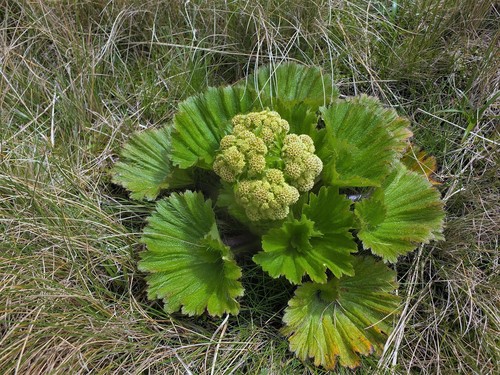
Azorella polaris is a large herbaceous rosette plant classified as a megaherb, growing up to 2 meters tall and 2 meters in diameter. It produces branched stems and thick, fleshy rhizomes that reach up to 4 centimeters thick. Its leaves have long, hairy petioles up to 60 centimeters long. The leaf blades are bright green, toothed, and have prominent veins; they measure 20–35 centimeters long by 30–45 centimeters wide, shaped suborbicular-reniform, fleshy, and very hairy with 1–2 centimeter appressed hairs, and are sometimes almost hairless on their underside. Flowers are arranged in compound axillary and terminal umbels that can grow up to 30 centimeters in diameter. The umbels sit at the tips of hairy peduncles 10–15 centimeters long. Each individual flower grows from a pedicel up to 1 centimeter long, with entire bracts. The numerous flowers are roughly 5 millimeters wide, with waxy yellow petals that have a purple base. Fruits are subglobose, shiny, and 4–6 millimeters wide. Azorella polaris mainly produces fruits from November to February, and occasionally fruits in October or March. Azorella polaris is native to two New Zealand subantarctic island groups, the Campbell Island and Auckland Islands, and to Macquarie Island, an Australian subantarctic island. On Macquarie Island, it forms part of the dominant local vegetation. Many species of myxomycetes have been found growing on Azorella polaris and another megaherb, Pleurophyllum hookeri, since these two species are the primary substrates available for slime moulds.