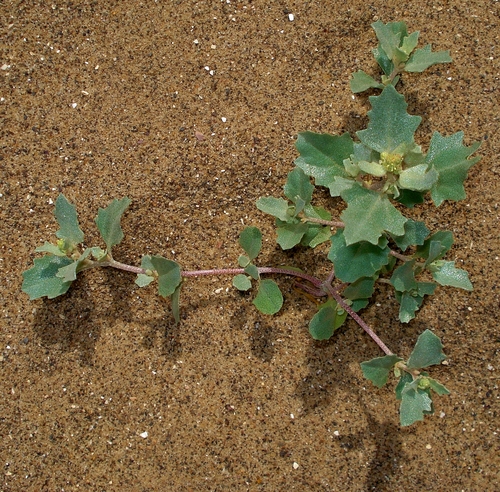
About Atriplex laciniata L.
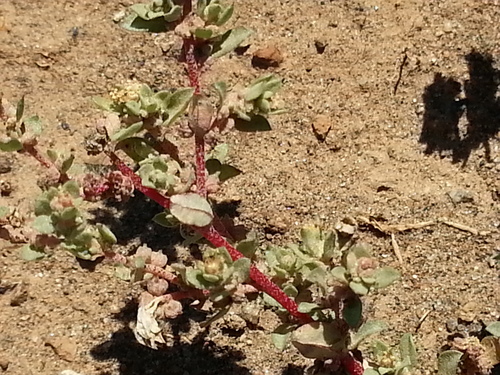
Atriplex laciniata L., commonly known as frosted orache, is a monoecious annual herb that grows to approximately 30 cm tall, with decumbent to ascending stems that sprawl across sandy beaches or mixed sand and shingle beaches. It has a short taproot and many widely spreading fibrous side roots. Its stems are typically red, densely covered in white mealy hairs, and often heavily branched. Leaves grow in an alternate arrangement: lower leaves are broadly rhombic in shape, around 4 cm long, with a cuneate base, at least 2 large lobes, and often several broad teeth along their margins. Upper leaves become progressively narrower, and leaves within the inflorescence are almost linear. All leaves have a short petiole roughly 0.5 cm long, and are silvery-grey, scaly or mealy in texture, especially on their lower surfaces. Flowering occurs in late summer. The inflorescence is a panicle made up of short spikes of dense silvery-white glomerules, which are clusters of 2–4 tiny, petal-less flowers. The species produces two types of flowers: male flowers are around 1 mm across, with 4 or 5 tiny tepals and 4 or 5 stamens; female flowers consist of an ovary with a short style and two stigmas, positioned between two bracteoles that enlarge to around 10 mm long at maturity. These mature bracteoles are broadly triangular with deeply toothed margins, often have a warty surface, shift from green to black in colour, retain a silvery-grey mealy coat, and are fused at least halfway up to the tip. The mature fruit is a brown, round achene (seed) about 5 mm in diameter, slightly flattened into a disc shape, with the incipient root (radicle) pointing upward within the enclosing bracteoles. Globally, frosted orache is a quite rare species, largely restricted to the Atlantic coasts of western Europe, ranging from northern Spain to Denmark and Sweden, with most populations concentrated around Britain and Ireland. In Norway, it occurs mainly on some southern beaches, and small outlying populations exist on the Mediterranean coasts of Spain, France and Corsica. It is scattered or common along the entire coastline of Britain and Ireland, including Shetland, Orkney, and the Channel Isles, and has apparently increased in range over recent decades, particularly around Ireland. Even with this increase, it generally forms small, often transient populations. Unlike many other coastal species, there is no evidence that frosted orache has successfully spread onto salt-treated roadsides. There has been longstanding confusion about the species' occurrence in North America, due to its close similarity to Atriplex canescens. Early reported sightings from Virginia were identification errors, even though Linnaeus himself listed it as an American species in Species Plantarum. Some sources still list it as an introduced species across a broad area from New York state to Newfoundland, while others report it is very rare at best. The strongest confirmed evidence of its presence in North America comes from a short stretch of the Canadian coast from Nova Scotia to New Brunswick, and it has definitively been photographed on Prince Edward Island, Canada. Frosted orache is not considered at risk of extinction, though it has not undergone a global threat assessment. In Britain and France, where it is most abundant, it is classified as LC (Least Concern), and in Britain and Ireland it is recognized as an axiophyte in all coastal counties, meaning it is taken into account when designating conservation sites such as nature reserves, and can be used for ecological monitoring. This species grows on sandy beaches, between the mean spring high tide line and the equinoctial high tide line. The strandline vegetation it inhabits is classified as habitat 1210 in the EUNIS habitat classification system, and in Britain it occurs in the SD2 Honkenya peploides-Cakile maritima strandline community, or sometimes the SD1 Rumex crispus-Glaucium flavum vegetation community found on mixed sand and shingle beaches. This strandline habitat is destroyed every year by exceptional tides with a coefficient of 100–120, so frosted orache is adapted to complete its full life cycle over the summer months and tolerate salty water at shallow depths. Older sources claimed that this type of beach has particularly high fertility from rotting seaweed mixed into sand, but more recent studies show that while this can be true in some cases, sandy beaches are usually very nutrient poor. Frosted orache is primarily wind-pollinated, but is also capable of self-pollination. In Britain, only two (possibly three) insect species are known to form galls on frosted orache: Hayhurstia atriplicis, an aphid that infests leaves and causes the leaf blade to swell and curl; Trioza chenopodii, a bug whose nymphs roll leaves without causing any thickening; and Stefaniella brevipalpis, a midge that inhabits stems, which still requires confirmation as a British species. Several more insect parasites of frosted orache exist across the rest of Europe. Eupithecia sinuosaria, the goosefoot pug, is an Asian species that has spread westward in recent years, and its larvae feed on frosted orache flowers. Another moth species, Goniodoma auroguttella, has larvae that build a case from the plant's bracteoles and feed on developing fruit, before migrating to the base of the plant to pupate inside the stem and emerge in spring. This moth only occurs in the Mediterranean populations of frosted orache, where the narrow tidal range allows more plants to overwinter. Finally, the micromoth Scrobipalpa atriplicella (common name goosefoot groundling) has larvae that create leaf mines in frosted orache and other Amaranthaceae species.