About Ptilotus obovatus (Gaudich.) F.Muell.
Growth Form
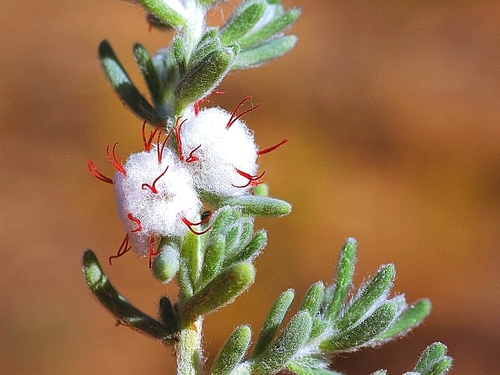
Ptilotus obovatus is a spreading or rounded, much-branched perennial shrub or subshrub that usually reaches 1 metre (3 feet 3 inches) in height. Its stems and foliage are densely covered in white, woolly hairs.
Leaf Characteristics
Leaves are arranged alternately, shaped egg-shaped to elliptic, sometimes with the narrower end at the base, and measure 12–50 millimetres (0.47–1.97 inches) long by 4–17 millimetres (0.16–0.67 inches) wide.
Inflorescence Structure
Flowers are arranged in oblong to short-cylindrical spikes that are 10–25 millimetres (0.39–0.98 inches) long and 10–20 millimetres (0.39–0.79 inches) wide, and often grow near the ends of branches. Each flower has five hairy pink or purplish perianth segments 5–9 millimetres (0.20–0.35 inches) long, with one bract and two sepal-like bracteoles at the base.
Stamen Features
This species has three or four stamens, including one or two staminodes.
Flowering and Fruit
Flowering can occur year-round, and the mature fruit is 1–2 millimetres (0.039–0.079 inches) long and 0.5–1 millimetre (0.020–0.039 inches) wide.
Common Name and Distribution
Commonly called smoke bush, this species is widespread and common across Western Australia, South Australia, the Northern Territory, and Queensland.
Conservation Status
In Victoria, it is rare and classified as endangered under Victoria's Flora and Fauna Guarantee Act 1988.