About Atriplex gardneri (Moq.) D.Dietr.
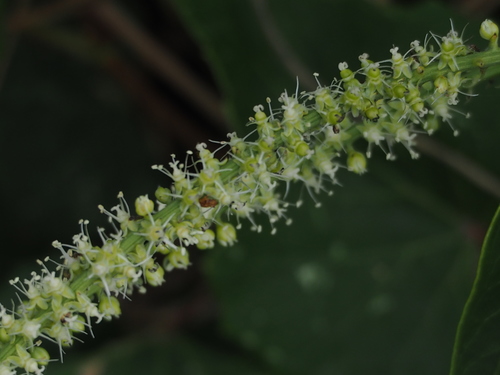
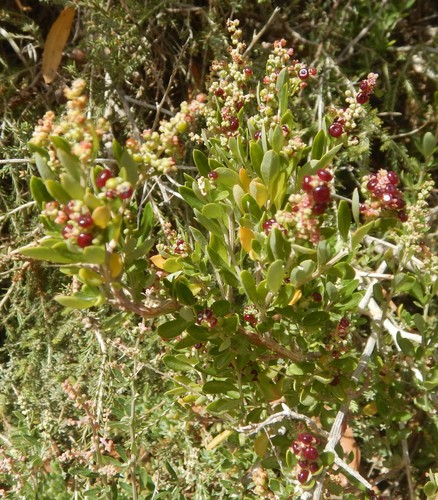
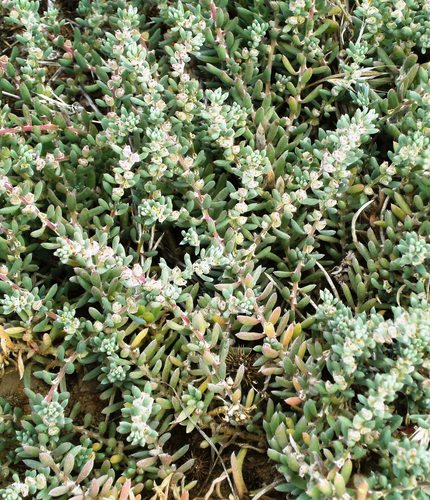
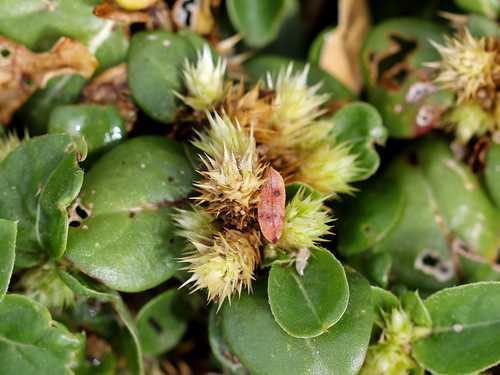
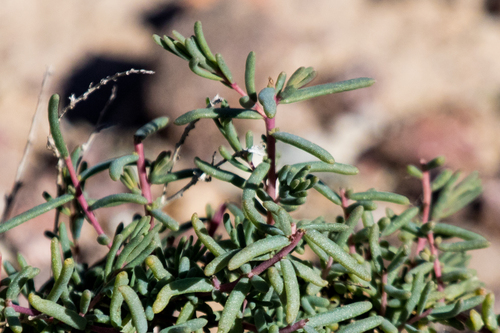
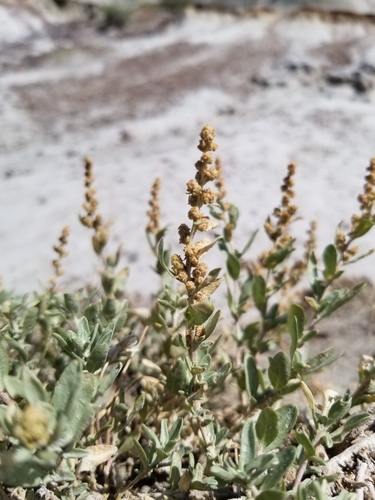
Atriplex gardneri is a flowering plant species in the amaranth family, commonly known as Gardner's saltbush. It is native to western North America, ranging from British Columbia to Saskatchewan in Canada, and extending south to Nevada and New Mexico in the United States. The species' specific epithet gardneri is an error; it was named for the plant's first collector Alexander Gordon, as naturalist Alfred Moquin-Tandon mistakenly believed Gordon's last name was Gardner. This species is currently treated as a complex of several varieties, and the species as a whole is variable in appearance. Varieties differ in ploidy level, with documented diploid, triploid, tetraploid, hexaploid, and other forms. Diploid and polyploid individuals often occupy different habitat types. The varieties intergrade with one another, and can hybridize with each other as well as with other Atriplex species such as Atriplex corrugata. In general, this plant is a shrub or subshrub that grows between 10 centimeters (3.9 inches) and 1 meter (3.3 feet) in height. Its stems may be prostrate or upright. Leaves can be arranged oppositely or alternately, and vary in shape and size; leaf color ranges from green to grayish green. The species may be dioecious or monoecious, meaning male and female flower parts are found on separate plants or the same plant, respectively. Flower color varies across the different varieties. The plant produces many seeds, and reproduces via seed, resprouting, and layering. One classification recognizes the following varieties: A. g. var. aptera, called Nelson's saltbush, native to the Great Plains; A. g. var. bonnevillensis, called Bonneville saltbush, native to Nevada and Utah; A. g. var. cuneata, called Castle Valley saltbush, found in Utah, Colorado, and New Mexico; A. g. var. falcata, called Jones' saltbush, found in the western United States; A. g. var. gardneri, a widespread variety; A. g. var. utahensis, called basin saltbush, found in the western United States; and A. g. var. welshii, called Welsh's saltbush, which usually grows alongside var. cuneata. Like many other Atriplex species, this plant is commonly found in salty and alkaline soils, which may be either clay or sandy. It is a component of multiple types of saltbush-greasewood plant communities, where the two shrub types often grow together. In some habitats it acts as a climax species, but it also colonizes areas during secondary succession after habitat disturbance. This species is considered fire-resistant, as it contains low levels of flammable oils and high levels of ash and similar compounds. If burned, the plant regrows quickly by resprouting from its roots. It is sometimes planted in fuelbreaks in California. The plant's leaves are a relatively nutritious food source for animals including antelope, some rabbit species, and pronghorn. It provides important minimum nutrition for pregnant female sheep (ewes). This species blooms from May to August.